

Strong glutes do much more than change how a pair of jeans fits. Your gluteus maximus is a major hip extensor, meaning it helps drive you upward from a squat, stand you up from a chair, and produce force when you run, jump, or climb. The gluteal muscles also work with the rest of the hip and trunk musculature to control lower body movement. For a beginner, building strength here is a practical investment in training performance as well as muscle development.
The barbell is an excellent tool because it makes progressive loading simple. You can begin with an empty bar, learn a repeatable movement, and add a small amount of weight only when your technique and control allow it. That matters more than chasing a difficult variation or trying to create a sensation of burn in every set. Long term strength and muscle gains come from consistent, progressive resistance training that you can recover from and repeat.



The three exercises below give you complementary ways to train the glutes with a barbell. The barbell hip thrust challenges hip extension most strongly near lockout. The back squat trains the glutes alongside the quads through a large lower body movement. The Romanian deadlift loads the glutes and hamstrings while teaching the hip hinge. Together, they are a simple and highly effective foundation.
What Makes a Good Beginner Barbell Glutes Exercise?
The best exercises for a beginner are not necessarily the ones that create the highest muscle activity in a laboratory during one repetition. Surface electromyography can show how much a muscle is electrically active during an exercise, but it does not directly measure long term muscle growth. What matters in the gym is whether you can perform the exercise through a controlled range of motion, add load gradually, and maintain sound technique across weeks and months.
3 Best Cable Back Exercises for a More Attractive V Shaped Torso
That is why this article uses three stable, bilateral barbell movements. Bilateral movements let both feet stay on the floor, making it easier to learn balance, bracing, and bar control. They also provide a clear route for progression. Research on resistance training supports using multiple sets, practicing movements regularly, and increasing the challenge over time as performance improves. You do not need to reach failure on every set to make progress. In fact, leaving one or two good repetitions in reserve often makes it easier for beginners to keep technique consistent and build quality training volume.
Before you start, use a rack with safety arms for squats when available. Ask a qualified coach to check your form if you are new to barbell lifting, especially if you have pain, a recent injury, or a medical condition that affects training. Muscle effort and normal post exercise soreness are expected. Sharp pain, joint pain, numbness, or a sudden loss of control are signals to stop and get appropriate advice.
1. Barbell Hip Thrust
Why It Belongs in Your Program
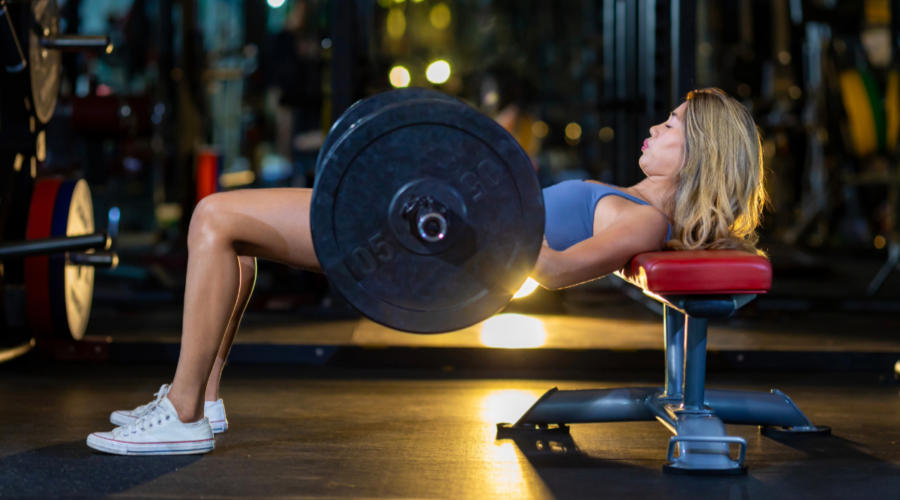
The barbell hip thrust is a direct hip extension exercise. With your upper back supported on a bench and your feet planted on the floor, you drive the hips upward against the barbell and finish with the hips extended. It is especially useful for beginners because the bar path is short, the setup can be standardized, and the exercise is easy to load in small increments.
Research comparing common loaded hip extension exercises has reported high gluteus maximus activity during the barbell hip thrust. A nine week training study also found that hip thrusts and back squats produced similar gluteal hypertrophy, although strength improvements were most specific to the lift being practiced. That is a valuable reminder: hip thrusts are not magic, but they are a strong choice for directly practicing and progressively loading hip extension.
How to Do It
Set a sturdy bench behind you and sit on the floor with the barbell over your hip crease. A padded barbell pad or folded mat can make the movement more comfortable. Roll the bar into position, lean your upper back against the bench, and place your feet about shoulder width apart. At the top, aim for your shins to be close to vertical.
Brace your trunk, keep your chin gently tucked, and drive through the whole foot to raise your hips. Finish when your ribs and pelvis feel stacked and your body forms a straight line from shoulders to knees. Squeeze the glutes at the top without throwing your lower back into a hard arch. Lower under control until your hips are close to the floor, then repeat.
Start with two or three sets of eight to twelve repetitions using a load that lets you stay controlled. Rest for about two minutes between sets. When you can complete the top end of the rep range with the same clean form, add a small amount of weight next time.
Common Beginner Errors
The most common error is mistaking lower back extension for hip extension. If you feel the movement mostly in your lower back at lockout, reduce the load and finish the repetition with your ribs down rather than flared. Another common issue is allowing the knees to cave inward. Keep the knees tracking in the same direction as the toes and use a stance that feels stable instead of forcing an excessively wide position.
Do not rush the setup. If the bench slides, the bar rolls unpredictably, or you cannot get into position with confidence, begin with a lighter barbell, a lower bench, or a bodyweight bridge while you practice the pattern.
2. Barbell Back Squat
Why It Belongs in Your Program
The back squat trains much more than the glutes, and that is one of its strengths. The glutes, quadriceps, adductors, trunk musculature, and other muscles contribute as you lower and stand up with the bar. It is a highly practical movement for building general lower body strength while giving the glutes a substantial training stimulus.
Studies of squat and hip thrust training show that both movements can build the gluteal muscles. The squat has an added advantage for beginners who want a single exercise that trains the thighs and glutes together. Research also indicates that increasing external load raises estimated forces in the gluteus maximus and other lower body muscles during squat based movements. You do not need an extreme depth or a very heavy barbell on day one. A repeatable depth that you can control without pain is the correct starting point.
How to Do It
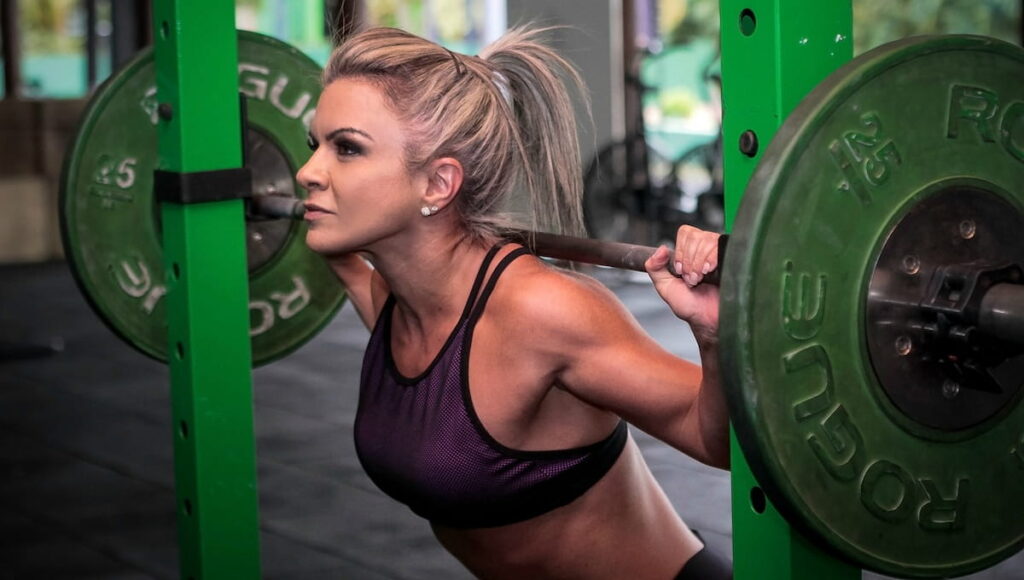
Set the bar in a rack at about upper chest height. Step under it, place it securely across the upper back rather than the neck, and grip it firmly. Stand up to lift the bar clear of the hooks, then take one or two controlled steps back. Set your feet roughly shoulder width apart with toes turned out as much as your hip comfort requires.
Take a breath, brace your trunk as though preparing for a gentle punch, and sit down between your hips while bending the knees. Keep the whole foot in contact with the floor and allow the knees to travel in the same direction as the toes. Descend only as far as you can keep your balance and spinal position under control. Drive the floor away to stand up, keeping the bar balanced over the middle of the foot.
For most beginners, two or three sets of six to ten repetitions works well. Begin with the empty bar if necessary. The right load is one that allows smooth, repeatable repetitions without the chest collapsing forward or the hips shifting noticeably to one side.
Common Beginner Errors
Avoid looking sharply upward or downward. Keep your head and neck neutral, with your gaze fixed on a point ahead of you. Do not let the heels lift or allow the bar to drift forward away from the middle of your foot. These changes often make the lift feel less stable and can encourage compensations.
Do not force yourself into another person’s stance or depth. Hip anatomy, mobility, and experience vary. Use a stance that lets you keep balance, control, and comfort. A box squat to a stable target can be a useful temporary learning tool, but avoid collapsing onto the box. Touch it lightly and stand with the same control you used to descend.
3. Barbell Romanian Deadlift
Why It Belongs in Your Program
The Romanian deadlift teaches the hip hinge, which is the ability to move the hips back while maintaining a stable trunk. It trains the posterior chain, including the glutes, hamstrings, and spinal erectors. Compared with the conventional deadlift, it starts from the standing position and keeps the bar close to the body, which can make it easier for beginners to practice the descent slowly and learn where their hips should move.
Research on Romanian, stiff leg, and elevated Romanian deadlift variations has found substantial posterior chain muscle activity in all three. Other research comparing barbell deadlifts and hip thrusts found that the hip thrust produced greater gluteus maximus activity than the deadlift variation tested, while the barbell deadlift challenged the biceps femoris more. That does not make the Romanian deadlift a lesser glute exercise. It makes it a useful complement to the hip thrust, because it loads the glutes in a different hip position and adds meaningful hamstring work.
How to Do It
Stand tall holding a barbell with an overhand grip, hands just outside your thighs. Unlock the knees so they remain softly bent, then hold that knee angle fairly steady. Take a breath, brace your trunk, and push your hips backward as the bar travels down close to your legs.
Lower until you feel a strong stretch in the hamstrings and can still keep the back in a neutral, controlled position. The bar does not need to reach the floor. For many beginners, it will stop below the knees or around mid shin. Drive the hips forward to stand tall, finishing with the glutes rather than leaning backward.
Perform two or three sets of eight to twelve repetitions. Use a light load and a deliberate lowering phase while you learn. The goal is not to chase the deepest possible range. The goal is to find the deepest range where your hips continue moving back and your trunk remains controlled.
Common Beginner Errors
The biggest error is turning the Romanian deadlift into a squat by bending the knees more and more as the bar descends. Keep a small knee bend, then focus on moving the hips back. Another error is allowing the bar to drift away from the legs. Keep it close. This gives you a more efficient bar path and makes the position easier to control.
Do not round your back to make the bar travel farther. End the descent when your range of motion runs out. Over time, strength, coordination, and tolerance may allow a larger comfortable range, but there is no benefit to forcing it during your first weeks.
How to Build These Exercises Into a Beginner Plan
Train the glutes two times per week on nonconsecutive days. On the first day, perform the back squat first, then the hip thrust, then the Romanian deadlift. On the second day, put the hip thrust first, then the Romanian deadlift, then the squat. Changing the order gives each exercise a chance to be performed while you are fresh across the week.
Start at the lower end of the suggested set and repetition ranges. Your first goal is simply to make every repetition look similar. Add repetitions until you reach the upper end of the range, then add the smallest practical load increase and return to the lower end. This approach is easy to track and gives connective tissues, coordination, and confidence time to adapt with the muscles.
As a general rule, finish most sets with about one or two repetitions in reserve. In plain English, you should feel that you could complete one or two more good repetitions if you absolutely had to. This keeps effort high enough to learn and improve without routinely practicing breakdown in technique. If your form changes markedly during a set, stop there even if you have not reached the planned number of repetitions.
Nutrition, sleep, and consistency determine whether the plan works in real life. Resistance training creates the stimulus, but muscles adapt between sessions. Eat sufficient food and protein for your goal, sleep as well as your circumstances allow, and return to the same lifts often enough to improve your skill. The boring fundamentals work because they let you accumulate many good sessions.
The Bottom Line
You do not need a complicated glutes workout to get started. The barbell hip thrust, back squat, and Romanian deadlift cover the main patterns a beginner needs: horizontal hip extension, squatting, and hinging. Each can be scaled with an empty bar or light load, practiced with consistent technique, and progressed over time.
Make your first priority form that you can repeat. Make your second priority gradual progression. If you do those two things for months instead of days, your glutes, legs, and overall lower body strength will have a reason to adapt.
References
- American College of Sports Medicine (2009) ‘American College of Sports Medicine position stand. Progression models in resistance training for healthy adults’, Medicine and Science in Sports and Exercise, 41(3), pp. 687–708.
- Andersen, V., Fimland, M.S., Mo, D.A., Iversen, V.M., Vederhus, T., Rockland Hellebø, L.R., Nordaune, K.I. and Saeterbakken, A.H. (2018) ‘Electromyographic comparison of barbell deadlift, hex bar deadlift, and hip thrust exercises: a cross over study’, Journal of Strength and Conditioning Research, 32(3), pp. 587–593.
- Coratella, G., Tornatore, G., Longo, S., Esposito, F. and Cè, E. (2022) ‘An electromyographic analysis of Romanian, step Romanian, and stiff leg deadlift: implications for resistance training’, International Journal of Environmental Research and Public Health, 19(3), 1903.
- Plotkin, D.L., Rodas, M.A., Vigotsky, A.D. et al. (2023) ‘Hip thrust and back squat training elicit similar gluteus muscle hypertrophy and transfer similarly to the deadlift’, Frontiers in Physiology, 14, 1279170.
- Robinson, Z.P., Pelland, J.C., Remmert, J.F., Refalo, M.C., Jukic, I., Steele, J. and Zourdos, M.C. (2024) ‘Exploring the dose response relationship between estimated resistance training proximity to failure, strength gain, and muscle hypertrophy: a series of meta regressions’, Sports Medicine, 54(9), pp. 2209–2231.
- Schoenfeld, B.J., Ogborn, D. and Krieger, J.W. (2017) ‘Dose response relationship between weekly resistance training volume and increases in muscle mass: a systematic review and meta analysis’, Journal of Sports Sciences, 35(11), pp. 1073–1082.
- Krause Neto, W., Soares, E.G., Vieira, T.L., Aguiar, R., Chola, T.A., Sampaio, V.L. and Gama, E.F. (2020) ‘Gluteus maximus activation during common strength and hypertrophy exercises: a systematic review’, Journal of Sports Science and Medicine, 19(1), pp. 195–203.
- Kipp, K., Kim, H. and Wolf, W.I. (2022) ‘Muscle forces during the squat, split squat, and step up across a range of external loads in college aged men’, Journal of Strength and Conditioning Research, 36(2), pp. 314–323.
Key Takeaways
| Exercise | Main role | Beginner focus |
|---|---|---|
| Barbell hip thrust | Directly loads hip extension, particularly near the top position | Keep ribs and pelvis stacked, then add load gradually |
| Barbell back squat | Builds glutes, thighs, and general lower body strength together | Use a stable stance, controlled depth, and a consistent bar path |
| Barbell Romanian deadlift | Trains the hip hinge with glutes and hamstrings | Push hips back, keep the bar close, and stop before control is lost |
| Weekly progression | Turns practice into measurable progress | Train twice weekly and add weight only after clean repetitions |