

Wider shoulders can make the upper body look stronger, more athletic, and more balanced. The good news is that beginners do not need a complicated shoulder routine with six different raises, machines, and cable variations. They need a small number of exercises that train the three visible portions of the deltoid muscles consistently and with good technique.
The deltoid has three main portions. The anterior deltoid sits at the front of the shoulder, the lateral deltoid sits on the outside, and the posterior deltoid sits at the back. If your goal is shoulder width, the lateral deltoid deserves particular attention because it adds size to the outside of the upper arm. However, strong and well developed front and rear deltoids help create a fuller shoulder and support more balanced training.



The three exercises below are enough to build an excellent beginner shoulder program: the dumbbell shoulder press, the dumbbell lateral raise, and the chest supported rear delt raise. Together, they cover the main movements that the deltoids perform and give you a simple plan that can progress for months.
Why Wider Shoulders Need More Than Pressing
Many beginners assume that pressing exercises are all they need for shoulder development. Pressing is valuable, but it mainly emphasizes the anterior deltoids and triceps. It can contribute to the lateral deltoids, particularly when performed with a full range of motion, but it is not the most direct way to add width to the shoulders.
Research comparing common shoulder and chest exercises has found that shoulder presses and lateral raises produce greater activation of the anterior and medial deltoids than the bench press and dumbbell fly. This matters because the lateral deltoid is the section most associated with the appearance of broad shoulders. A program that only includes presses may leave this area undertrained.
It is also worth remembering that muscle activation is not the same thing as long term muscle growth. An exercise can produce high activity in a muscle during one set without automatically being the best exercise for every person. Still, activation research can help identify which movements are likely to load a target muscle effectively. The best long term approach is to choose exercises you can perform safely, progress gradually, and repeat consistently.
Resistance training works especially well for beginners because the body adapts quickly to a new training stimulus. You do not need extreme workouts or advanced techniques. Regular practice, enough challenging sets, and gradual increases in repetitions or load will do far more for your shoulders than constantly changing exercises.
Exercise 1: Dumbbell Shoulder Press
The dumbbell shoulder press is the foundation of this routine. It trains the anterior deltoids, contributes to the lateral deltoids, and also strengthens the triceps. It teaches you how to press weight overhead with control, which is a useful movement pattern for general strength and athletic performance.
Dumbbells are an excellent choice for beginners because each arm works independently. This can make it easier to notice side to side differences and encourages each shoulder to contribute to the lift. Compared with a fixed barbell path, dumbbells also allow many lifters to use a pressing path that feels more natural for their individual shoulder structure.
How to Perform the Dumbbell Shoulder Press
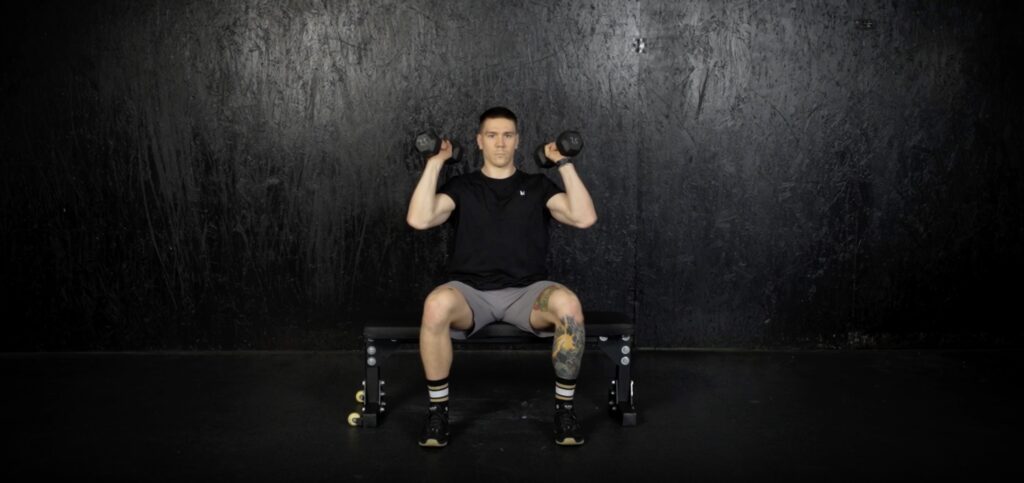
Sit on an upright bench with your feet planted firmly on the floor. Hold the dumbbells around shoulder height with your elbows slightly in front of your body rather than pulled directly out to the sides. Keep your chest tall and gently brace your abdominal muscles.
Press the dumbbells upward until your arms are almost straight. You do not need to forcefully lock your elbows or crash the weights together at the top. Lower the dumbbells slowly back to shoulder height, keeping control throughout the repetition.
The movement should feel like a strong upward press, not a dramatic backward lean. If you have to arch your lower back to get the weights overhead, the dumbbells are probably too heavy or you are losing your brace.
Why It Works
The shoulder press loads the deltoids through a large range of motion and allows beginners to build strength progressively. Research has shown that the shoulder press produces substantial activation of the anterior deltoid and meaningful activation of the medial deltoid. It is therefore an efficient way to develop overall shoulder mass while improving overhead pressing strength.
Start with two or three sets of six to 12 repetitions. Choose a load that makes the final few repetitions challenging while still allowing you to keep a stable torso and controlled path. Rest for around two minutes before repeating the set.
Exercise 2: Dumbbell Lateral Raise
If wider shoulders are the priority, the dumbbell lateral raise is the exercise you should take most seriously. It trains shoulder abduction, which is the action of lifting the arm away from the body. This movement places direct emphasis on the lateral deltoid.
The lateral deltoid does not usually receive enough direct work from pressing alone. That is why lateral raises are so important. They are not flashy, and the weights will be much lighter than your pressing weights, but they can make a major difference to shoulder shape over time.
How to Perform the Dumbbell Lateral Raise
Stand tall with a dumbbell in each hand by your sides. Keep a soft bend in your elbows and set your shoulders down away from your ears. Raise the dumbbells outward and slightly forward until your upper arms are around shoulder height.
Lower the weights under control and repeat. Think about moving your upper arms away from your body rather than trying to lift the dumbbells with your hands. Your hands are simply holding the weights. Your shoulders should do the work.
Use a weight that lets you control the repetition without swinging your torso. A small amount of natural movement is normal, but large swings turn the exercise into a momentum drill and reduce the tension on the lateral deltoids.
Why It Works
Research examining deltoid activity during resistance exercises has consistently found that lateral raise variations strongly recruit the medial deltoid. In comparisons of common shoulder and chest movements, lateral raises were among the most effective exercises for the medial deltoid.
The lateral raise also gives beginners something that the shoulder press cannot fully provide: direct work for the muscle that adds the most obvious visual width. This is why the lateral raise belongs in almost every shoulder building plan.
Aim for two or three sets of 10 to 20 repetitions. Higher repetitions often work well here because the lateral deltoid can be trained effectively with relatively light dumbbells. The final repetitions should be difficult, but your form should remain controlled.
Exercise 3: Chest Supported Rear Delt Raise
The chest supported rear delt raise finishes the routine by training the posterior deltoids. These muscles sit at the back of the shoulder and help move the upper arm backward and outward. They also contribute to a more complete, rounded shoulder appearance when viewed from the side and back.
Many beginners perform plenty of presses, push ups, and chest exercises while doing little direct work for the back of the shoulder. That imbalance can leave the shoulder routine incomplete. Adding a rear delt movement gives your training more balance and encourages better attention to the muscles that are often overlooked.
How to Perform the Chest Supported Rear Delt Raise
Set an adjustable bench to a low incline and lie face down with your chest supported. Hold a light dumbbell in each hand with your arms hanging toward the floor. Keep a slight bend in your elbows and raise your arms outward until they are roughly level with your torso.
Pause briefly near the top, then lower the dumbbells slowly. Keep your neck relaxed and avoid shrugging your shoulders toward your ears. The chest support is useful because it reduces the temptation to use the lower back and hips to swing the weights.
Do not chase heavy dumbbells with this exercise. The rear deltoids are smaller muscles, and clean repetitions matter more than the number written on the dumbbell.
Why It Works
The posterior deltoid contributes to balanced shoulder development and is active during several pulling and shoulder movements. Research comparing deltoid activation during common exercises found that lateral raise patterns can recruit the posterior deltoid, while shoulder pressing also produces more posterior deltoid activity than chest pressing movements. A dedicated rear delt raise gives beginners a straightforward way to train this part of the shoulder with less assistance from the chest, triceps, and lower back.
Chest support makes the exercise especially beginner friendly. It gives you a stable position, helps you focus on the target muscles, and makes it easier to use consistent technique from one session to the next.
3 Best Beginner Glutes Exercises with Dumbbells (Get Super Strong Now!)
Perform two or three sets of 10 to 20 repetitions. Stop the set when you can no longer lift the dumbbells smoothly without shrugging, swinging, or turning the movement into a row.
The Simple Beginner Shoulder Plan
Perform these exercises twice per week, leaving at least one day between sessions. You can add them to an upper body workout or perform them after a full body strength session.
Start with the dumbbell shoulder press because it is the most demanding movement and requires the most coordination. Follow with lateral raises, then finish with chest supported rear delt raises. This order lets you use your best energy and concentration on the lift that requires the most strength.
For the first few weeks, two sets of each exercise is enough for most beginners. As your technique improves and recovery remains good, progress to three sets. This gives you 12 to 18 direct shoulder sets per week across two sessions, which is a productive amount of practice without making the plan unnecessarily complicated.
Research suggests that muscle growth can occur across a wide range of repetition numbers when sets are performed with enough effort. Heavier loads are useful for building strength, while lighter loads can still stimulate hypertrophy when the set is challenging. For beginners, this means you do not need to force every movement into the same repetition range. Presses often feel comfortable in a moderate range, while lateral and rear delt raises often work better with lighter weights and more repetitions.
How to Progress Without Overcomplicating It
The most reliable form of progress is simple. Keep a record of the weight and repetitions you use. When you can complete the top end of your target repetition range with clean form for every set, increase the load slightly at the next workout.
For example, if you perform two sets of 12 dumbbell shoulder presses with a given weight and both sets are controlled, move up to the next available dumbbell weight. Your repetitions may drop back toward six or eight, which is completely normal. Build them up again over the following sessions.
For lateral raises and rear delt raises, the smallest dumbbell increase can feel large. If your gym has small increments, use them. If not, add repetitions first, improve control, slow the lowering phase slightly, or add an extra set once your current volume feels manageable.
You do not need to train every set to complete failure. Stopping with one to three good repetitions still available is a practical way for beginners to train hard while preserving technique. Training too close to failure with poor form can turn a productive shoulder exercise into a sloppy full body movement.
Common Mistakes That Limit Shoulder Growth
The first mistake is using too much weight on lateral raises. If your torso is swinging back and forth, your upper traps are taking over, or your elbows are bending and straightening dramatically, reduce the load. Lighter dumbbells performed with control will be more useful.
The second mistake is neglecting the rear delts. Beginners often favor exercises they can load heavily, which usually means presses and chest work. The rear delt raise may feel humbling, but it helps create a more balanced shoulder routine and should not be treated as optional.
The third mistake is changing exercises every week. Variety can be useful later, but beginners benefit from practicing the same basic movements. Repeating the dumbbell shoulder press, lateral raise, and chest supported rear delt raise lets you improve technique and clearly measure progress.
The final mistake is expecting rapid visual changes. Beginners can make excellent strength and muscle gains, but wider shoulders are built through months of consistent training, sufficient food intake, sleep, and gradual progression. The simple plan is powerful precisely because it is easy to repeat.
The Bottom Line
You do not need a complicated shoulder workout to build wider shoulders. A dumbbell shoulder press develops overall pressing strength and front shoulder size. A dumbbell lateral raise directly targets the muscle most responsible for visible shoulder width. A chest supported rear delt raise completes the routine by training the back of the shoulder and supporting more balanced development.
Train these three exercises twice per week, use controlled repetitions, and progress patiently. For a beginner, that is more than enough to build a strong foundation and noticeably broader shoulders.
References
- Campos, Y.A.C., Vianna, J.M., Guimarães, M.P., de Oliveira, J.L., Hernández Mosquera, C. and Marchetti, P.H. (2020) ‘Different shoulder exercises affect the activation of deltoid portions in resistance trained individuals’, Journal of Human Kinetics, 75, pp. 5 to 14.
- Lasevicius, T., Ugrinowitsch, C., Schoenfeld, B.J., Roschel, H., Tavares, L.D., De Souza, E.O., Tricoli, V. and Teixeira, E.L. (2018) ‘Effects of different intensities of resistance training with equated volume load on muscle strength and hypertrophy’, European Journal of Sport Science, 18(6), pp. 772 to 780.
- Schoenfeld, B.J., Ogborn, D. and Krieger, J.W. (2017) ‘Dose response relationship between weekly resistance training volume and increases in muscle mass: A systematic review and meta analysis’, Journal of Sports Sciences, 35(11), pp. 1073 to 1082.
- Schoenfeld, B.J., Grgic, J., Ogborn, D. and Krieger, J.W. (2017) ‘Strength and hypertrophy adaptations between low versus high load resistance training: A systematic review and meta analysis’, Journal of Strength and Conditioning Research, 31(12), pp. 3508 to 3523.
- Steele, J., Fisher, J., Giessing, J. and Gentil, P. (2017) ‘Clarity in reporting terminology and definitions of set endpoints in resistance training’, Muscle & Nerve, 56(3), pp. 368 to 374.
Key Takeaways
| Focus | What beginners should do | Why it matters |
|---|---|---|
| Main exercises | Use dumbbell shoulder presses, lateral raises, and chest supported rear delt raises | These movements train the front, side, and rear portions of the deltoids |
| Priority for width | Give lateral raises consistent effort and controlled form | The lateral deltoid has the greatest influence on visible shoulder width |
| Weekly frequency | Train shoulders twice per week | Repeated practice supports technique, progressive overload, and sufficient training volume |
| Repetitions | Use six to 12 repetitions for presses and 10 to 20 for raises | Different exercises can be trained effectively with different loads and repetition ranges |
| Progression | Add repetitions first, then increase weight when form remains clean | Gradual progression gives the muscles a continuing reason to adapt |