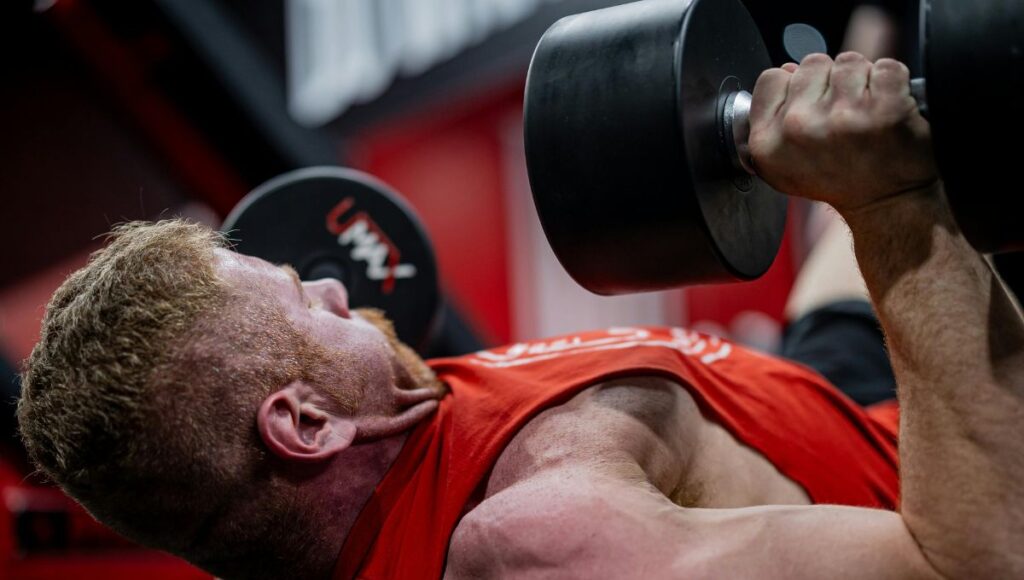
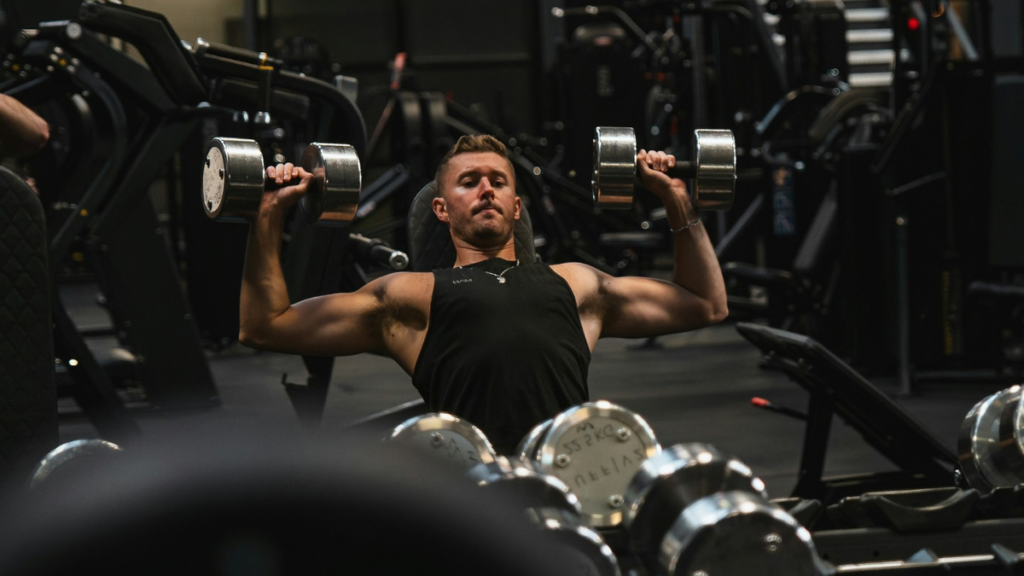
Add these movements into your training if you want to bulk up your arms.
Decoding Upper Arm Anatomy and Growth Mechanics
To understand why certain arm exercises outperform others, we must examine how the biceps brachii, triceps brachii, and brachialis actually function during human movement. Your upper arm is predominantly composed of the triceps on the posterior side, which accounts for roughly two thirds of total arm mass, while the biceps and brachialis sit on the anterior side. Traditional arm routines often fail because they rely exclusively on mid range contractions while completely ignoring the fully stretched and fully shortened positions where hypertrophic signaling peaks.
| Arm Compartment | Primary Anatomical Role | Optimal Mechanical Stimulus | Contribution to Mass |
|---|---|---|---|
| Triceps Brachii | Elbow extension and shoulder stabilization | Overhead and lengthened pressing paths | Approximately sixty percent |
| Biceps Brachii | Elbow flexion and forearm supination | Incline and supinated curling variations | Approximately thirty percent |
| Brachialis | Deep elbow flexion beneath biceps | Neutral grip and pronated movements | Ten percent plus frame width |
Understanding these functional divisions helps you avoid the common trap of random exercise selection. When you match your training choices to the actual mechanics of your upper arm, every single repetition contributes directly to balanced muscle growth and structural fullness.
5 Dumbbell Exercises for Jacked Arms Faster
Selecting the right dumbbell movements for an accelerated arm building routine requires balancing mechanical safety with maximum hypertrophic efficiency. The five dumbbell exercises detailed below represent the gold standard for developing powerful, jacked arms without requiring complicated machine setups or hazardous loads.
1. The Incline Dumbbell Bicep Curl
The incline dumbbell bicep curl is widely considered by biomechanists to be the single most effective movement for targeting the long head of the biceps brachii. By setting an adjustable bench to a forty five degree angle and letting your arms hang straight down behind your torso, you place the biceps into an extreme pre stretched position at the start of every repetition. Research indicates that training a muscle at long muscle lengths creates high mechanical tension and microtrauma that triggers robust hypertrophic adaptations compared to standard standing curls.
To execute this movement properly, sit back against an incline bench with your feet planted firmly on the floor and your arms hanging straight down holding dumbbells. Keeping your upper arms locked rigidly in place behind your torso, curl the weights upward while supinating your wrists so your palms face your shoulders at the top. Lower the dumbbells slowly along the exact same path over a three second eccentric count, feeling an intense stretch across the front of your arms at the bottom.
2. The Overhead Dumbbell Tricep Extension
Because the triceps make up the majority of your upper arm mass, prioritizing movements that target all three heads is essential for rapid growth. The overhead dumbbell tricep extension places the long head of the triceps into a fully stretched overhead position, which electromyography data proves produces exceptional muscle activation compared to pushdowns or standard kickbacks. Raising your arms overhead alters the tension curve, ensuring that your triceps experience maximum resistance precisely where the muscle is fully lengthened.
Hold a single heavy dumbbell with both hands, sit on a bench with back support, and press the weight straight up overhead with your elbows pointing forward. Lower the dumbbell in a smooth arc behind your head until your forearms touch your biceps, maintaining strict control throughout the descent. Drive the weight back up to full arm extension by contracting your triceps forcefully without allowing your elbows to flare outward.
| Exercise Selection | Primary Muscle Target | Main Biomechanical Benefit |
|---|---|---|
| Incline Dumbbell Curl | Biceps brachii long head | Maximizes stretch mediated hypertrophy at long lengths |
| Overhead Tricep Extension | Triceps long head | Targets deep stretch overhead for maximum activation |
| Seated Hammer Curl | Brachialis and forearm | Builds lower arm thickness and pushes biceps upward |
| Dumbbell Concentration Curl | Biceps short head peak | Eliminates momentum for strict peak contraction |
| Decline Dumbbell Skull Crusher | Lateral and medial triceps | Provides constant tension across entire press path |
3. The Seated Hammer Curl
Many lifters struggle to build wider looking arms because they focus exclusively on the biceps while completely ignoring the brachialis, a powerful muscle that sits underneath the biceps and pushes it outward. The seated hammer curl utilizes a neutral grip with your palms facing each other, which shifts the primary workload onto the brachialis and brachioradialis. Clinical studies show that neutral grip curling variations significantly increase total upper arm circumference by developing the lower arm structure that acts as a foundation for your biceps.
Sit on the edge of a flat bench holding dumbbells at your sides with a neutral grip where your palms face inward toward your thighs. Keeping your elbows tucked tightly against your ribs, curl the weights upward toward your shoulders without rotating your wrists or using momentum from your hips. Lower the dumbbells under strict control, feeling the deep contraction along the outer edges of your arms throughout the entire set.
4. The Dumbbell Concentration Curl
When it comes to isolating the bicep and achieving an intense localized pump, few exercises rival the classic dumbbell concentration curl. By sitting down and bracing your working elbow against the inside of your thigh, you completely eliminate any possibility of body swing or momentum assistance. Electromyography analysis demonstrates that strict isolation movements like the concentration curl produce remarkably high levels of localized motor unit recruitment in the short head of the biceps.
Sit on the edge of a bench with your feet wide apart, lean forward slightly, and press the back of your right upper arm against the inside of your right knee. Holding a dumbbell with your palm fully supinated, curl the weight upward toward your chest while squeezing your bicep as hard as possible at the top. Lower the dumbbell slowly back to full extension, maintaining complete focus on the working muscle fibers.
5. The Decline Dumbbell Skull Crusher
To finish off your arm development, the decline dumbbell skull crusher provides a unique resistance profile that challenges the lateral and medial heads of the triceps. Setting an adjustable bench to a slight decline angle alters the gravitational pull, keeping tension high even at the top of the movement where standard flat bench variations tend to lose resistance. Research indicates that declining angles reduce joint stress on the elbows while maximizing continuous tension across the entire triceps complex.
Lie back on a decline bench holding a pair of dumbbells with your arms extended straight up over your chest and your palms facing each other. Keeping your upper arms completely stationary, bend your elbows to lower the dumbbells down on either side of your head until your forearms reach parallel to the floor. Press the weights back up to the starting position by contracting your triceps powerfully through the elbows.
Structuring Your Arm Growth Program
Applying these five dumbbell principles effectively requires a balanced weekly programming schedule that accounts for both heavy compound loading and adequate recovery time. Arms are heavily involved during back and chest training, meaning they do not require marathon workout sessions to grow. Training your arms directly twice per week with high intensity and moderate volume yields optimal hypertrophic results.
Every Guy Needs These 3 Compound Exercises for a Strong and Jacked Body
The sample program below illustrates how to organize these evidence-backed dumbbell movements into a cohesive weekly routine that maximizes arm development without leading to overtraining.
| Training Session | Exercise Selection | Working Sets and Repetitions | Primary Training Focus |
|---|---|---|---|
| Session One | Incline Dumbbell Bicep Curl | 3 sets of 8 to 10 reps | Long head stretch and mechanical tension |
| Session One | Overhead Tricep Extension | 3 sets of 10 to 12 reps | Triceps long head lengthening and activation |
| Session One | Seated Hammer Curl | 3 sets of 10 to 12 reps | Brachialis development and arm width |
| Session Two | Decline Dumbbell Skull Crusher | 3 sets of 8 to 10 reps | Constant tension across lateral triceps heads |
| Session Two | Dumbbell Concentration Curl | 3 sets of 12 to 15 reps | Strict short head isolation and peak contraction |
Approaching your arm training with this level of scientific precision allows you to break through stubborn growth plateaus and build remarkably powerful, jacked arms in record time.
Key Takeaways
| Core Concept Label | Practical Application Summary |
|---|---|
| Anatomical Diversity | Upper arms require targeted movements for the biceps, triceps, and brachialis to achieve full development. |
| Stretch Mediated Growth | Use incline curls and overhead extensions to subject arm muscles to high tension at long lengths. |
| Neutral Grip Power | Incorporate hammer curls to target the brachialis and push the biceps outward for greater width. |
| Strict Execution | Eliminate momentum using seated and braced variations to maximize motor unit recruitment. |
References
- Bompa, T., and Haff, G. G. 2009. Periodization: Theory and methodology of training. 5th edn. Champaign: Human Kinetics.
- Campos, G. E., Luecke, T. J., Wendeln, H. K., Toma, K., Hagerman, F. C., Murray, T. F., Ragg, K. E., Ratamess, N. A., Kraemer, W. J., and Staron, R. S. 2002. Muscular adaptations in response to three different resistance-training regimens: Specificity of repetition maximum training zones. European Journal of Applied Physiology, 88(1), pp. 50-60.
- Schoenfeld, B. J. 2010. The mechanisms of muscle hypertrophy and their application to resistance training. Journal of Strength and Conditioning Research, 24(10), pp. 2857-2872.
- Wakahara, T., Miyamoto, N., Sugisat, N., Murata, K., Kanehisa, H., Kawakami, Y., and Fukunaga, T. 2013. Association between regional differences in muscle activation in one session of resistance exercise and in muscle hypertrophy after resistance training. European Journal of Applied Physiology, 113(4), pp. 939-947.