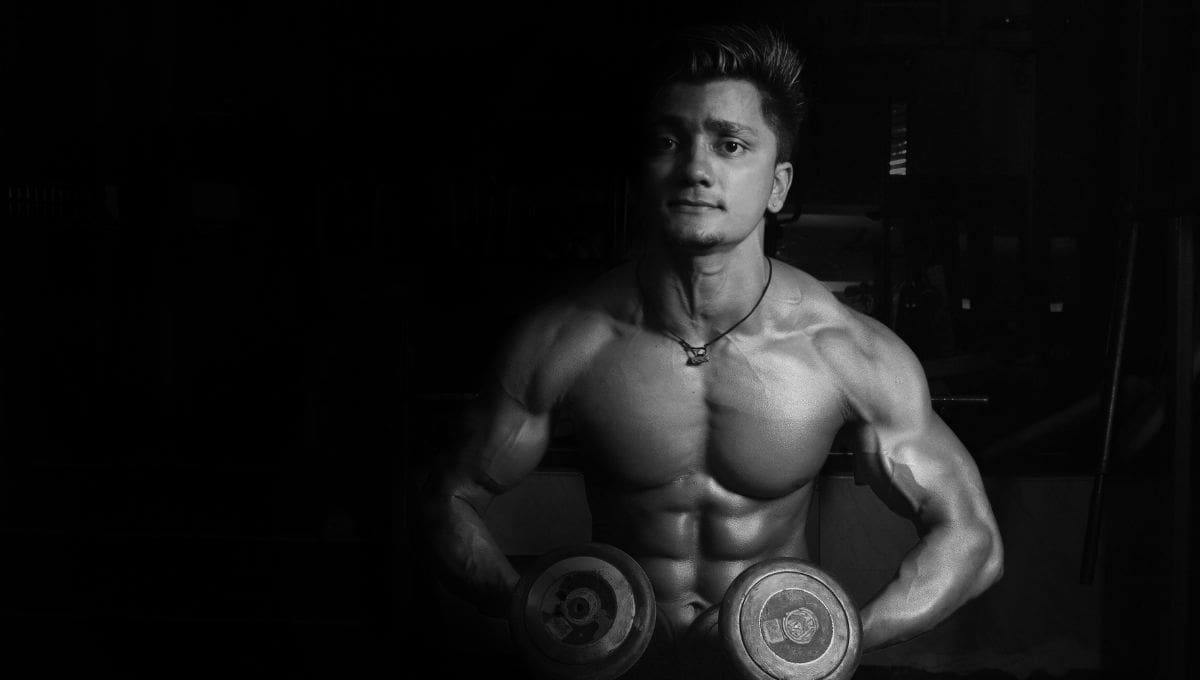


Building a bigger chest is not about finding one magic number of repetitions. Beginners can gain muscle across a wide range of reps, provided they use sound technique, train hard enough, and make gradual progress over time. Still, some rep ranges are more practical than others when you are learning to lift, especially for chest exercises such as the bench press, dumbbell press, chest press machine, push up, cable fly, and pec deck.
For most beginners, the best starting point is usually 6 to 12 reps for pressing exercises and 10 to 20 reps for isolation work. This range gives you enough load to create useful tension in the chest while allowing enough repetitions to practice control, improve coordination, and learn what a good chest contraction feels like. It also makes it easier to progress safely from week to week.


The important point is that repetitions are only one part of the muscle building equation. Your exercise selection, effort, total weekly training volume, recovery, and consistency all matter. A sensible rep range helps bring these pieces together.
What Actually Makes the Chest Grow?
Your pectoralis major is the large, fan shaped muscle across the front of the chest. Its fibers help bring the upper arm toward the body, move the arm across the torso, and assist with pressing motions. The pectoralis minor is a smaller muscle beneath it that helps control the shoulder blade. When people talk about building a muscular chest, they are mainly talking about developing the pectoralis major.
Resistance training stimulates muscle growth when the muscle is exposed to enough mechanical tension over time. Mechanical tension is created when the chest has to produce force against resistance, particularly through a controlled range of motion. The load can be heavy or relatively light, but the set needs to be challenging enough for the chest to do meaningful work.

Research shows that muscle growth can occur across a broad range of loads. Lighter sets can build comparable muscle to heavier sets when they are performed with sufficiently high effort, although heavier loads are generally better for maximizing strength. This matters because beginners do not have to jump immediately to very heavy bench presses to build their chest. Dumbbells, machines, cables, and bodyweight exercises can all be productive.
However, lighter loads often require longer and more uncomfortable sets. A set of 20 push ups close to your limit can be effective, but it may be harder to judge your technique and effort when fatigue becomes high. Moderate rep ranges are therefore an efficient and beginner friendly place to start.
The Best Chest Rep Range for Most Beginners
Use 6 to 12 Reps for Main Pressing Exercises
For exercises such as the barbell bench press, incline dumbbell press, flat dumbbell press, and chest press machine, aim for 6 to 12 controlled repetitions per set.
This range works well because it combines muscle building potential with manageable loads. You can use enough weight to feel the chest working hard, but you still have enough repetitions to refine your setup, bar path, range of motion, and control. Those technical skills are particularly important on free weight pressing movements.
Want More Muscular Shoulders? Do These 3 Barbell Exercises
A beginner using the bench press for sets of 6 to 10 reps will usually have more opportunity to practice stable shoulder positioning and a consistent pressing path than someone attempting very heavy sets of 2 or 3 reps. At the same time, they can usually use more load than they could for sets of 15 to 20 reps. This makes the range useful for building both muscle and foundational strength.
You do not need to stay at one exact rep number. For example, you might perform three sets of 8 to 10 reps on a machine chest press. Once you can complete 10 good reps on every set, increase the weight slightly and work back up from around 8 reps. This is a simple form of progressive overload.
Use 10 to 20 Reps for Chest Isolation Exercises
Exercises such as cable flys, pec deck flys, and dumbbell fly variations generally suit slightly higher reps. Aim for 10 to 20 repetitions with a load that allows steady control.
Isolation movements place the chest under tension without requiring the same level of whole body stability as a barbell press. They can be useful for adding more chest training volume after your main pressing work. Higher repetitions are often more comfortable for the shoulders and elbows on these exercises, especially when you choose a load you can control without swinging or shortening the movement.
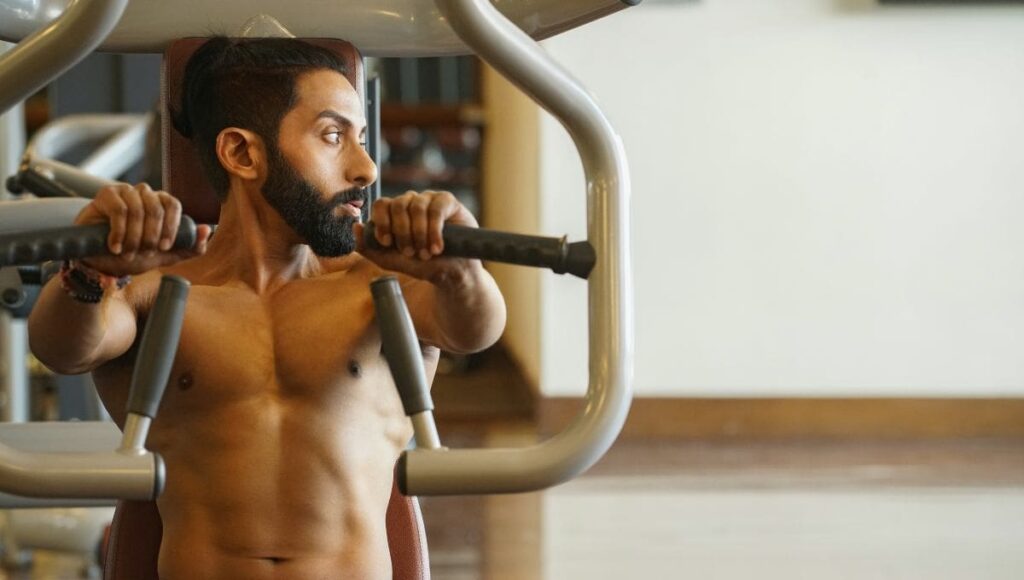
The goal with a fly is not to use the heaviest possible weight. The goal is to keep tension on the chest while moving the arms through a controlled arc. If the weight forces your shoulders to roll forward, your elbows to bend excessively, or your torso to rock backward, the load is too heavy for the intended exercise.
Use 8 to 15 Reps for Push Ups
Push ups are an excellent chest exercise for beginners because they teach you to press while controlling your body in space. They train the chest, triceps, front shoulders, and core together. For many beginners, sets of 8 to 15 quality repetitions are a practical target.
If standard push ups are too difficult, elevate your hands on a bench, Smith machine bar, or sturdy surface. This reduces the percentage of bodyweight you have to press while keeping the movement pattern intact. As your strength improves, lower the height of the incline until you can perform floor push ups with control.
If regular push ups are very easy, slow down the lowering phase, add a pause near the bottom, elevate your feet, or use a weighted vest. The exercise should become progressively harder as your strength improves.
How Close to Failure Should You Train?
A set needs to be challenging to stimulate muscle growth, but beginners do not need to take every set to complete failure. Training to failure means you cannot complete another repetition with proper technique. It can be useful at times, especially with safer machine and cable exercises, but it also creates more fatigue and can cause form to break down.
For most beginner chest work, finish your sets with approximately one to three repetitions in reserve. In practical terms, this means you should feel that you could probably complete only one, two, or three more good reps if you absolutely had to. The final repetitions should feel difficult, but your technique should remain recognizable.
This approach gives you room to learn. On a bench press, leaving a small margin helps you avoid rushed repetitions, unstable shoulders, and failed lifts. On a chest press machine or pec deck, you can occasionally work closer to failure because the movement is more stable and easier to stop safely.
As you gain experience, your ability to estimate effort improves. Early on, it is common to stop a set much too soon because the burn feels uncomfortable. The burn is not automatically a sign that the set is finished. At the same time, forcing extra repetitions with poor control is not productive. Quality reps are the priority.
How Many Sets Should Beginners Do?
Rep ranges only work in context. Your chest needs enough challenging sets across the week to create an effective growth stimulus. A beginner can usually make progress with a modest amount of direct chest work, particularly because pressing exercises also involve the triceps and shoulders.
A good starting point is around 6 to 10 hard chest focused sets per week. This can be spread across two workouts. For example, you might perform three sets of chest press and two sets of cable flys on one day, followed by three sets of incline dumbbell press and two sets of push ups on another day.
Weekly volume should be increased only when you are recovering well and progressing becomes difficult. More sets are not automatically better. If your chest, shoulders, and elbows remain sore for several days, your pressing strength is falling, or your technique is getting worse, you may be doing more than you can currently recover from.
Research suggests that greater weekly resistance training volume can support larger gains in muscle mass, but the relationship is not limitless. Beginners should first focus on getting stronger and more skilled with a manageable amount of quality work. Adding sets too quickly can make training feel exhausting without improving results.
A Simple Beginner Chest Workout Structure
Workout One
Start with a chest press machine for three sets of 8 to 12 reps. Use a seat height that lets the handles begin around mid chest level. Keep your upper back against the pad and avoid shrugging your shoulders toward your ears as you press.
Follow this with incline dumbbell presses for three sets of 8 to 12 reps. An incline set around 15 to 30 degrees can help train the upper chest while keeping the movement comfortable for most lifters. Lower the dumbbells with control, let your upper arms move slightly behind your torso if your shoulders tolerate it, then press without bouncing.
Finish with two sets of cable flys for 12 to 15 reps. Keep a soft bend in the elbows and think about bringing your upper arms toward one another rather than simply moving your hands.
Workout Two
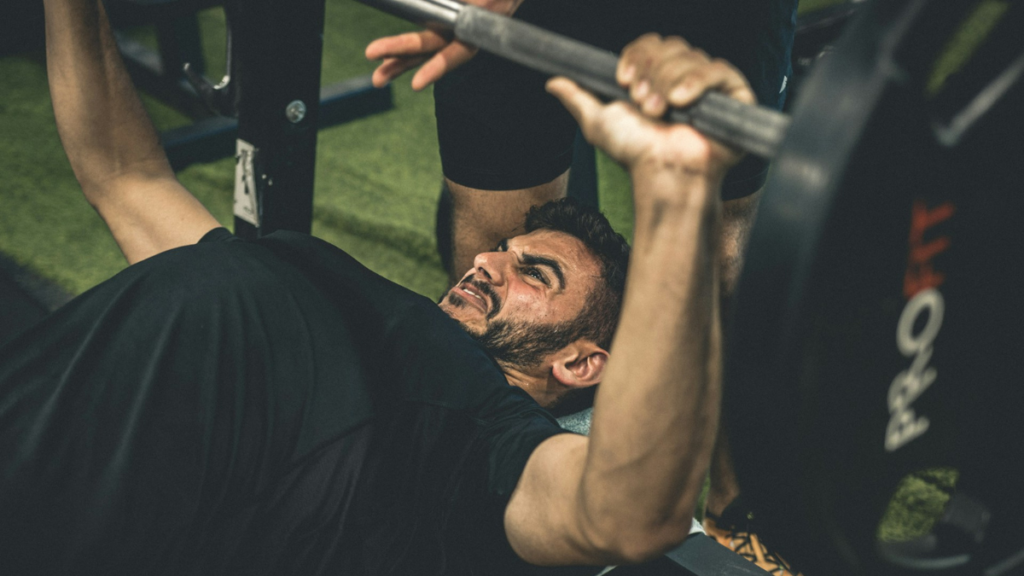
Begin with a barbell bench press or dumbbell bench press for three sets of 6 to 10 reps. If you choose the barbell bench press, use a weight that allows you to keep your feet planted, shoulder blades set, and bar path controlled. A spotter or safety arms are sensible when available.
Then perform three sets of elevated or standard push ups for 8 to 15 reps. Maintain a straight line from head to heel and lower your chest toward the surface rather than letting your hips sag.
Finish with two sets of pec deck flys for 12 to 20 reps. Move smoothly, pause briefly when the chest is shortened, and return under control. Do not let the weight stack crash between repetitions.
This routine gives a beginner 16 weekly chest focused sets. If that feels like too much at first, remove one set from each exercise. The best plan is the one you can recover from and repeat consistently.
Rest Periods Matter More Than Many Beginners Think
Rest long enough between sets to repeat good quality work. For chest pressing exercises, rest around two minutes as a useful starting point. Some people may need closer to three minutes after demanding bench press or dumbbell press sets. For cable flys and pec deck work, one to two minutes is often sufficient.
Very short rest periods can make a workout feel intense, but they may reduce the number of high quality repetitions you can perform on later sets. If the goal is muscle growth, you want to accumulate productive training volume rather than simply become tired as quickly as possible.
Rest is not wasted time. Use it to assess your technique, prepare for the next set, and record what you achieved. Training logs are valuable because they show whether you are actually improving. If you add a rep, improve your range of motion, use slightly more weight, or perform the same work with better control, you are making progress.
Common Rep Range Mistakes to Avoid
One common mistake is using very heavy weights before you have learned the movement. Low rep strength work has a place, but it is not the most efficient starting point for a beginner whose main goal is chest size. Sets of 6 to 12 reps give you more chances to practice each exercise while still using meaningful resistance.
Another mistake is using very light weights for endless repetitions. High rep training can build muscle, but sets become less practical when they are so easy that you can perform far beyond 20 or 30 repetitions without approaching fatigue. In that situation, make the exercise harder by adding resistance, choosing a more demanding variation, or slowing down the movement.
Finally, do not confuse soreness with growth. Some soreness is normal when you begin training or introduce a new exercise, but severe soreness does not mean the workout was better. Your aim is steady progress across months, not one punishing session that disrupts the rest of your training.
The Bottom Line
The best rep range for beginners building a muscular chest is not one narrow number. Use 6 to 12 reps for your main presses, 10 to 20 reps for flys and machine isolation work, and 8 to 15 reps for push ups. Train each set hard enough that you have only a small number of good reps left, but do not sacrifice technique to reach failure.
Focus on controlled repetitions, a full comfortable range of motion, gradual progression, and enough recovery between sessions. If you can consistently add reps or load while maintaining solid form, your chest has a strong reason to grow.
Key Takeaways
| Focus | Practical recommendation | Why it matters |
|---|---|---|
| Main pressing exercises | Perform 6 to 12 reps per set | This range combines muscle building tension with useful technique practice |
| Flys and machine isolation work | Perform 10 to 20 reps per set | Higher reps allow controlled chest focused work with manageable joint stress |
| Push ups | Perform 8 to 15 good repetitions | Push ups build pressing strength and can be adjusted to match your ability |
| Effort | Finish most sets with one to three reps in reserve | Hard sets stimulate growth while preserving form and recoverability |
| Weekly work | Start with 6 to 10 challenging chest sets per week | Beginners can progress well with manageable volume before adding more |
| Progression | Add reps first, then increase load gradually | Consistent progressive overload drives long term muscle gain |
| Rest periods | Rest around two minutes after pressing sets | Adequate rest helps maintain performance and quality training volume |
References
- American College of Sports Medicine (2009) ‘American College of Sports Medicine position stand: Progression models in resistance training for healthy adults’, Medicine and Science in Sports and Exercise, 41(3), pp. 687–708.
- Baz Valle, E., Schoenfeld, B.J., Torres Cantero, A., Campos Paredes, A., Balsalobre Fernández, C. and Alix Fages, C. (2024) ‘Exploring the dose response relationship between estimated resistance training proximity to failure, strength gain, and muscle hypertrophy: A series of meta regressions’, Sports Medicine, 54, pp. 2209–2231.
- Grgic, J., Schoenfeld, B.J., Davies, T.B., Lazinica, B., Krieger, J.W. and Pedisic, Z. (2018) ‘Effect of resistance training frequency on gains in muscular strength: A systematic review and meta analysis’, Sports Medicine, 48(5), pp. 1207–1220.
- Grgic, J., Schoenfeld, B.J., Skrepnik, M. and Davies, T.B. (2024) ‘Give it a rest: A systematic review with Bayesian meta analysis on the effect of inter set rest interval duration on muscle hypertrophy’, Frontiers in Sports and Active Living, 6, 1429789.
- Schoenfeld, B.J., Grgic, J., Ogborn, D. and Krieger, J.W. (2017) ‘Strength and hypertrophy adaptations between low versus high load resistance training: A systematic review and meta analysis’, Journal of Strength and Conditioning Research, 31(12), pp. 3508–3523.
- Schoenfeld, B.J., Ogborn, D. and Krieger, J.W. (2016) ‘Dose response relationship between weekly resistance training volume and increases in muscle mass: A systematic review and meta analysis’, Journal of Sports Sciences, 35(11), pp. 1073–1082.
- Schoenfeld, B.J., Grgic, J., Van Every, D.W. and Plotkin, D.L. (2021) ‘Loading recommendations for muscle strength, hypertrophy, and local endurance: A re examination of the repetition continuum’, Sports, 9(2), 32.