

Strong thighs make everyday movement easier, safer, and more powerful. They help you stand up from a chair, walk upstairs, run, jump, carry loads, and maintain control when you change direction. They also support the knee and hip joints by helping you absorb force and create stability during movement.
For beginners, the goal is not to chase complicated exercises or use the heaviest possible weight. The best starting point is to master a small number of movements that train the large muscles of the thighs through a comfortable range of motion. Consistent resistance training can improve lower body strength, muscle size, physical function, and confidence in daily movement.


The thighs include the quadriceps at the front of the leg, the hamstrings at the back, and the adductors along the inner thigh. Although individual exercises can place more emphasis on certain muscles, the most useful beginner movements train the thighs as part of a coordinated lower body action. This improves strength that transfers to real life and sport.
The three exercises below are beginner friendly, effective, and easy to progress. Start with control, use a range of motion you can own, and add load or repetitions gradually as your technique improves.
Why Strong Thighs Matter
Strong thigh muscles contribute to better lower body function throughout life. The quadriceps are particularly important for tasks such as rising from a chair, climbing stairs, and controlling the body during walking. Reduced quadriceps strength is associated with poorer physical function in older adults, while improving lower body strength can improve the ability to perform daily activities.
Thigh strength also matters for knee health. The knee relies on the coordinated action of the muscles around it to control movement and distribute force. The quadriceps, hamstrings, and hip muscles all contribute to knee stability during squatting, stepping, landing, and changing direction. Building strength does not make someone invincible, but it can improve the capacity of the tissues to manage physical demands.

Resistance training is also one of the most reliable ways to build or maintain muscle mass. This matters for beginners because more muscle can support long term strength, mobility, metabolic health, and independence. You do not need an advanced program to get results. Research shows that properly performed resistance training can increase strength across a wide range of populations, including people who are new to exercise.
The key is to train regularly, use enough effort to challenge the muscles, and increase the difficulty over time. For most beginners, two or three lower body sessions per week is a practical starting point.
1. The Bodyweight Squat
Why the Bodyweight Squat Works
The bodyweight squat is one of the best first exercises for stronger thighs because it teaches a fundamental movement pattern. It trains the quadriceps, glutes, adductors, hamstrings, and trunk muscles while requiring no equipment. It also resembles movements you already perform in everyday life, particularly sitting down and standing up.
During a squat, the quadriceps work hard to straighten the knees as you rise. The glutes help extend the hips, while the adductors and hamstrings contribute to control and force production. The muscles of the trunk work to keep the torso stable. This makes the squat an efficient exercise when you want to improve lower body strength without making a workout unnecessarily complicated.
For beginners, bodyweight squats are valuable because they allow you to learn balance, coordination, and comfortable depth before adding external load. You can adjust the movement to suit your current ability by squatting to a chair, holding onto a sturdy support, or reducing the depth slightly. These changes allow you to train the same pattern while building confidence.
How to Do It
Stand with your feet around shoulder width apart. Let your toes point slightly outward if that feels natural for your hips and ankles. Keep your feet flat on the floor and spread your weight across the heel, big toe, and little toe of each foot.
Are Bar Facing Burpees the Perfect Exercise for Burning Body Fat?
Take a breath, brace your stomach gently, and begin by bending at the hips and knees. Lower yourself as though you are sitting down toward a chair behind you. Keep your chest comfortably upright and allow your knees to travel in the same direction as your toes.
Descend only as far as you can while staying balanced and controlled. Then press through your whole foot to stand back up. Finish tall without forcefully leaning backward.
A useful starting point is two or three sets of eight to 12 repetitions. Rest for around one to two minutes between sets. The final few repetitions should feel challenging, but your technique should remain stable.
Common Beginner Mistakes
Many beginners rush the lowering phase and lose control at the bottom. Slowing down makes it easier to stay balanced and gives the thigh muscles more time under tension. A controlled squat also helps you learn whether your current range of motion is appropriate.
Another common issue is allowing the heels to rise from the floor. This can happen when ankle mobility is limited or when the person shifts too far forward. Try widening your stance slightly, reducing the depth, or placing a small weight plate under your heels if needed. Over time, improving ankle mobility and practicing the movement can make deeper squats more comfortable.
Do not worry if your knees move forward over your toes during a squat. Forward knee movement is normal in many squat variations. The more important goal is to keep the knees tracking in line with the toes and to avoid painful movement.
How to Progress It
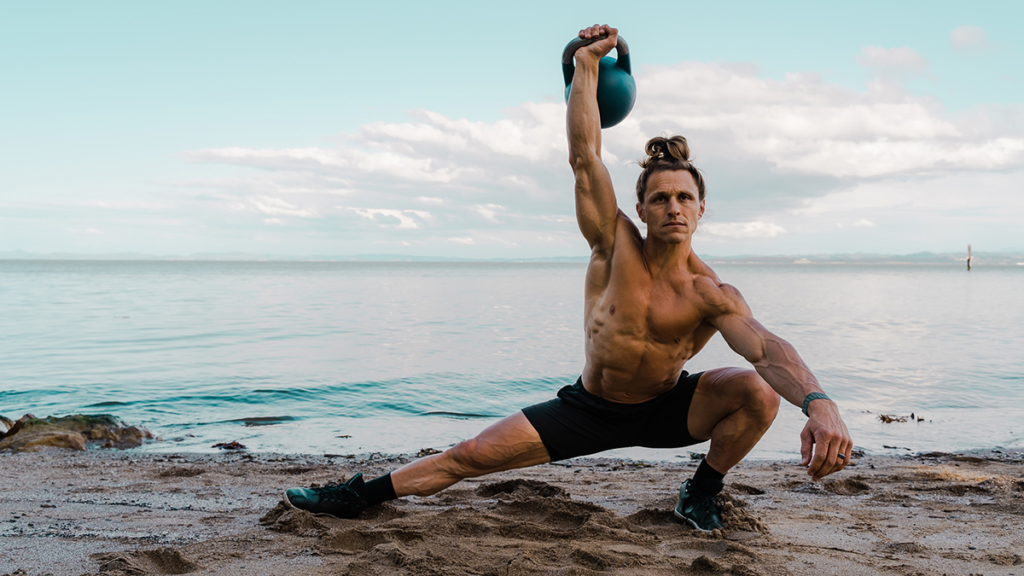
Once you can perform three controlled sets of 12 repetitions, progress by adding a light dumbbell or kettlebell in front of your chest. This variation is called the goblet squat. Holding weight in front of the body can help some beginners keep a more upright position while increasing the challenge for the thighs.
You can also make bodyweight squats harder by slowing the descent to three seconds, pausing briefly near the bottom, or gradually increasing the range of motion. These are useful options when you do not have access to weights.
2. The Reverse Lunge
Why the Reverse Lunge Works
The reverse lunge is an excellent beginner exercise because it trains one leg at a time. Single leg training can reveal differences in balance, strength, and coordination between the left and right sides. It also challenges the quadriceps, glutes, hamstrings, adductors, and stabilizing muscles around the hips.
In a reverse lunge, the front leg does most of the work as you lower and rise. The quadriceps of the front leg help control the descent and extend the knee as you return to standing. The glutes help straighten the hip, while the muscles around the pelvis work to keep the body steady.
Stepping backward is often easier for beginners than stepping forward. A forward lunge requires you to decelerate your body as your foot lands, which can feel less stable. The reverse lunge lets you begin from a balanced standing position and place the rear foot behind you with more control.
How to Do It
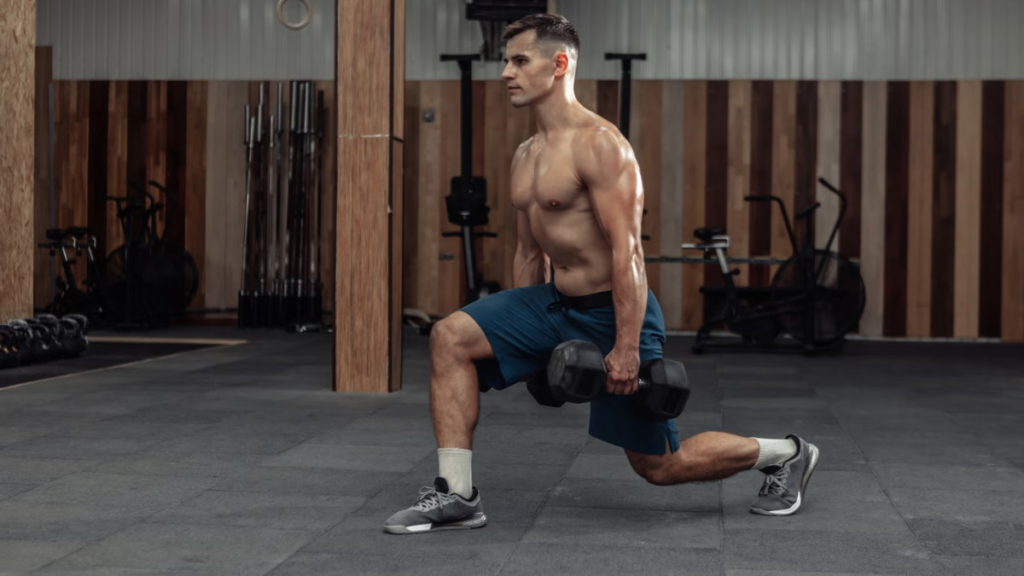
Stand tall with your feet about hip width apart. Shift most of your weight into one foot, then take a controlled step backward with the other foot. Lower your back knee toward the floor while keeping your torso upright and your front foot flat.
At the bottom, both knees should be bent comfortably. The front knee should track in the same direction as the front toes. Press through the front foot to return to the starting position, bringing the rear foot back under your body.
Begin with two or three sets of six to 10 repetitions on each side. Move slowly enough that you can maintain your balance. If you feel unsteady, lightly hold a wall, countertop, or stable support with one hand.
How to Make the Reverse Lunge More Comfortable
A shorter backward step usually places more emphasis on the quadriceps of the front leg, while a longer step may increase the contribution from the hip muscles. Neither option is automatically better. Choose the step length that lets you lower smoothly without knee pain or loss of balance.
If the full movement is too difficult, perform a split squat instead. Set your feet in a staggered position and keep them there as you lower and rise. This removes the stepping element and allows you to focus on building strength. Once that feels comfortable, return to the reverse lunge.
You can also reduce the depth by placing a cushion or yoga block under the rear knee as a target. Gradually increase the depth as your strength and confidence improve.
How to Progress It
The easiest progression is to hold a light dumbbell in each hand. Keep the weights at your sides and make sure they do not pull your torso forward. Add load only when you can complete all repetitions with stable knee alignment and controlled balance.
Another option is to increase repetitions before adding weight. For example, move from six repetitions per leg to eight, then 10. Gradual progression gives your muscles, tendons, and coordination time to adapt.
3. The Step Up
Why the Step Up Works
The step up is a practical thigh exercise because it closely resembles climbing stairs. It trains the quadriceps and glutes of the working leg while demanding balance, coordination, and control. The hamstrings and lower leg muscles also help stabilize the movement.
Step ups are useful because they teach you to produce force through one leg. This can carry over well to walking uphill, climbing stairs, hiking, and many sporting movements. The exercise can be easily adjusted by changing the height of the platform, making it suitable for a wide range of beginner fitness levels.
Research on resistance training supports the use of multi joint lower body exercises for improving strength and functional capacity. The step up provides this type of training while remaining accessible. It does not require a barbell, a gym machine, or advanced mobility.
How to Do It
Choose a stable step, box, or bench that is low enough for you to control the movement. For most beginners, a height around the middle of the shin or lower is a sensible place to start. Place one whole foot on the platform and keep your knee in line with your toes.
Press through the foot on the platform and stand up without aggressively pushing off the floor with the trailing leg. Bring the other foot onto the platform and stand tall. Step down carefully under control, then repeat on the same side.
Keep your torso steady and avoid collapsing forward over the working leg. Focus on using the leg on the platform to lift your body. If you need to use a handrail or wall for balance, that is completely fine.
Perform two or three sets of eight to 12 repetitions per leg. Rest long enough that each set is controlled. If your form becomes sloppy, reduce the step height or stop the set earlier.
Common Beginner Mistakes
The most common mistake is using too high a platform. A very high step can force the body into an awkward position and make it tempting to push hard with the foot on the floor. Start lower than you think you need. You can always increase the height later.
Another issue is dropping quickly on the way down. The lowering portion of the exercise is valuable because the quadriceps work to control the descent. Step down slowly and quietly, keeping the working knee aligned with the toes.
Avoid letting the knee collapse inward. This often happens when the platform is too high, the person is fatigued, or balance is limited. Use a lower step, slow down, and hold a support if necessary.
How to Progress It
When you can complete your sets with smooth, controlled repetitions, increase the step height slightly or hold light dumbbells at your sides. You can also use a slower lowering phase to make the exercise more demanding without immediately adding weight.
The best progression is the one that lets you keep excellent technique. A small increase performed consistently is more productive than a large jump that forces poor movement.
How to Build These Exercises Into a Beginner Routine
A simple approach is to perform all three exercises twice per week on nonconsecutive days. Start with two sets of each exercise and gradually build toward three sets as your fitness improves. Use a repetition range that lets you maintain control, generally between six and 12 repetitions for each set.
Your workout could begin with bodyweight squats, followed by reverse lunges and step ups. Squats come first because they use both legs and allow you to practice the primary lower body pattern while you are fresh. Lunges and step ups then add single leg strength and balance work.

Do not train through sharp pain, swelling, or a feeling that something is wrong. Normal muscular effort and mild soreness after a new exercise can occur, but pain that changes how you move deserves attention. If you have a current injury, recent surgery, or a health condition that affects exercise, seek guidance from an appropriately qualified health professional.
Consistency matters more than perfection. Learn the movements, train with a level of effort that challenges you, and progress gradually. Over time, these three exercises can build stronger thighs that improve both your training and everyday life.
References
- American College of Sports Medicine (2009) ‘American College of Sports Medicine position stand: Progression models in resistance training for healthy adults’, Medicine & Science in Sports & Exercise, 41(3), pp. 687–708.
- Fragala, M.S., Cadore, E.L., Dorgo, S., Izquierdo, M., Kraemer, W.J., Peterson, M.D. and Ryan, E.D. (2019) ‘Resistance training for older adults: Position statement from the National Strength and Conditioning Association’, Journal of Strength and Conditioning Research, 33(8), pp. 2019–2052.
- Grgic, J., Schoenfeld, B.J., Skrepnik, M., Davies, T.B. and Mikulic, P. (2020) ‘Effects of rest interval duration in resistance training on measures of muscular strength: A systematic review’, Sports Medicine, 48(1), pp. 137–151.
- Kritz, M., Cronin, J. and Hume, P. (2009) ‘The bodyweight squat: A movement screen for the squat pattern’, Strength and Conditioning Journal, 31(1), pp. 76–85.
- Lesinski, M., Hortobágyi, T., Muehlbauer, T., Gollhofer, A. and Granacher, U. (2015) ‘Effects of resistance training on physical performance in healthy older adults: A systematic review and meta analysis’, Sports Medicine, 45(12), pp. 1669–1686.
- McCurdy, K., O’Kelley, E., Kutz, M., Langford, G., Ernest, J. and Torres, M. (2010) ‘Comparison of lower extremity EMG between the 2 leg squat and modified single leg squat in female athletes’, Journal of Sport Rehabilitation, 19(1), pp. 57–70.
- Schoenfeld, B.J., Ogborn, D. and Krieger, J.W. (2017) ‘Dose response relationship between weekly resistance training volume and increases in muscle mass: A systematic review and meta analysis’, Journal of Sports Sciences, 35(11), pp. 1073–1082.
- Segal, N.A., Boyer, E.R., Wallace, R., Torner, J.C. and Yack, H.J. (2015) ‘Association between chair stand strategy and mobility limitations in older adults with symptomatic knee osteoarthritis’, Archives of Physical Medicine and Rehabilitation, 94(2), pp. 375–383.
- Suchomel, T.J., Nimphius, S. and Stone, M.H. (2016) ‘The importance of muscular strength in athletic performance’, Sports Medicine, 46(10), pp. 1419–1449.
- Westcott, W.L. (2012) ‘Resistance training is medicine: Effects of strength training on health’, Current Sports Medicine Reports, 11(4), pp. 209–216.
Key Takeaways
| Exercise | Main thigh benefits | Beginner starting point | Simple progression |
|---|---|---|---|
| Bodyweight squat | Builds coordinated strength in the quadriceps, glutes, adductors, and trunk | Two to three sets of eight to 12 controlled repetitions | Add a light goblet weight, a pause, or a slower descent |
| Reverse lunge | Develops single leg thigh strength, balance, and knee control | Two to three sets of six to 10 repetitions per side | Add repetitions, then hold light dumbbells |
| Step up | Strengthens the quadriceps and glutes in a movement similar to climbing stairs | Two to three sets of eight to 12 repetitions per side using a low step | Increase step height slightly or add light dumbbells |