

Dumbbells are one of the best tools a beginner can use to build bigger, more balanced legs. They are accessible, easy to adjust, and allow you to train each side of your body with attention and control. You do not need a barbell, a leg press, or a complicated machine routine to make meaningful progress.
The key is choosing exercises that cover the major functions of the lower body. Your quads need knee bending and straightening under load. Your glutes need to produce force through the hips. Your hamstrings need both hip extension and knee control. A good beginner program also needs unilateral work, where each leg works independently, because it makes it easier to spot and address meaningful strength differences between sides.


Resistance training increases muscle size and strength when it is performed consistently and progressed over time. Current evidence shows that building muscle depends less on owning a particular type of equipment and more on accumulating challenging, well executed training volume. Dumbbells can do that extremely well, especially when you use a full range of motion and gradually increase the load, repetitions, or quality of your sets.
The three exercises below provide a simple and complete foundation. The dumbbell goblet squat trains the quads, glutes, and adductors. The dumbbell Romanian deadlift develops the hamstrings and glutes. The dumbbell split squat makes each leg contribute on its own, helping you build size while exposing side to side differences that can otherwise be hidden in bilateral exercises.
Why Dumbbell Training Works for Beginner Leg Growth
Beginning with dumbbells has practical advantages. Each hand holds its own load, so you can move naturally and keep the weight close to your body. This makes it easier to learn the important patterns of squatting, hinging, and lunging without the technical demands of a barbell.
Dumbbells also allow you to make smaller increases in load. A beginner does not need to make dramatic jumps every week. Adding a few pounds, completing an extra repetition with the same weight, or improving depth and control can all be forms of progressive overload. These gradual improvements are what keep the muscles adapting.
For muscle growth, effort matters. Your working sets should be challenging enough that you have only a small number of clean repetitions left before your form would begin to break down. You do not need to train to complete failure on every set. In fact, beginners often progress better when they leave a little room for technical consistency, recovery, and confidence.
A complete leg routine should not chase soreness or complexity. It should give the quads, glutes, and hamstrings enough hard work across the week, while allowing you to repeat good technique often enough to improve. These three dumbbell movements achieve that without turning your first leg program into an exhausting list of exercises.
1. Dumbbell Goblet Squat
The goblet squat is the best starting squat for many beginners. You hold one dumbbell vertically against your chest, which gives you a natural counterbalance as you sit down between your hips. The position encourages an upright torso and makes it easier to learn a controlled squat pattern.
What Muscles Does the Goblet Squat Train?
The goblet squat primarily trains the quadriceps, which are the muscles on the front of the thighs. The glutes and adductors also contribute strongly as you stand up from the bottom position. Your trunk muscles work to keep the rib cage and pelvis controlled while the dumbbell pulls your body forward.
This makes the goblet squat an efficient exercise for overall lower body size. It trains several large muscle groups in one movement and gives beginners plenty of opportunity to practice a pattern that transfers to everyday activities, athletic positions, and future strength training exercises.
Squats performed through a comfortable, controlled depth can be an effective choice for building lower body strength and muscle. A full range of motion is generally useful because it asks the muscles to produce force over more of the movement. Your ideal depth depends on your mobility, proportions, and ability to maintain a stable foot position and controlled spine.
How to Do the Dumbbell Goblet Squat
Hold a dumbbell upright with both hands under the top plate and position it close to the center of your chest. Stand with your feet around shoulder width apart, although a slightly wider stance may feel better for some people. Turn the toes out slightly if that helps your knees track comfortably.
Take a breath, gently brace your trunk, and sit down by allowing the knees and hips to bend together. Keep your whole foot connected to the floor. Your knees should move in the same direction as your toes rather than collapsing inward. Lower until you reach a depth you can control without your heels lifting or your lower back rounding excessively.
Push the floor away and stand tall. Think about keeping the dumbbell close to your body throughout the repetition. Finish with the hips and knees straight, but do not lean backward at the top.
Common Goblet Squat Mistakes
A common error is holding the dumbbell too far away from the chest. This pulls the torso forward and makes the movement harder to control. Keep the dumbbell close, with your elbows angled down.
Chin-Ups vs Pull-Ups – Which Is Better for Wider and Bigger Arms?
Another mistake is rushing the lowering phase. Use a steady descent of roughly two to three seconds, especially while you are learning. This makes it easier to find a repeatable depth and prevents the bottom position from becoming loose or unstable.
Do not force your knees to stay perfectly vertical. In a well performed squat, the knees will usually travel forward to some degree. What matters is that the movement is controlled, your feet stay planted, and the knees track comfortably over the toes.
How to Program It
Start with two or three sets of eight to 12 repetitions. Rest for around two minutes between sets so that your breathing settles and you can keep the next set technically sound. Choose a weight that feels demanding near the end of the set but still allows you to squat with control.
When you can complete the top end of the repetition range with excellent form for every set, increase the dumbbell weight if possible. If your next dumbbell jump is too large, add repetitions gradually, slow the lowering phase slightly, or add another set.
2. Dumbbell Romanian Deadlift
The dumbbell Romanian deadlift is one of the most useful beginner exercises for building the back of the legs. It teaches the hip hinge, which is different from a squat. Instead of bending deeply at the knees, you move the hips backward while maintaining a long, controlled spine.
What Muscles Does the Dumbbell Romanian Deadlift Train?
The Romanian deadlift places substantial demand on the hamstrings and glutes. The hamstrings are challenged as they lengthen while the hips move backward, then help extend the hips as you return to standing. The glutes also produce hip extension, while the muscles of the trunk and upper back stabilize the body and keep the dumbbells close.
This is important for leg symmetry because your lower body should not be built only from quad focused movements. Strong, well developed hamstrings and glutes contribute to a more complete leg physique and help create balance between the front and back of the thighs.
Research comparing hamstring exercises has found high hamstring activity during the Romanian deadlift. Although muscle activation data cannot predict muscle growth on its own, it supports the Romanian deadlift as a useful exercise when the goal is to train the posterior side of the legs.
How to Do the Dumbbell Romanian Deadlift
Stand tall with a dumbbell in each hand, held in front of your thighs with the palms facing your legs. Set your feet about hip width apart and soften your knees slightly. This small knee bend should remain fairly consistent throughout the exercise.
Begin the movement by pushing your hips backward. Let the dumbbells slide down close to your thighs and shins. Keep your chest open and your back neutral, but do not try to force an exaggerated arch in your lower back. Your torso will naturally tip forward as the hips travel backward.
Lower the dumbbells until you feel a strong stretch in the hamstrings and can still maintain control. For many beginners, this will be around knee level or mid shin, but depth is not a competition. Then press your feet into the floor, squeeze the glutes, and stand back up by bringing the hips forward.
Common Romanian Deadlift Mistakes
The biggest mistake is turning the exercise into a squat. If the knees keep bending more as you lower, the quads will take over and the hamstrings will receive less of the intended challenge. Keep a soft knee bend, but focus on moving the hips backward.
Another common mistake is allowing the dumbbells to drift away from the body. Keep them close to the legs. This improves control and prevents unnecessary stress on the lower back.
Some people also lower farther than their current mobility allows. Stop the repetition when your pelvis starts to tuck under, your back loses position, or the dumbbells can no longer stay close. Greater range of motion is useful only when you can own it.
How to Program It
Perform two or three sets of eight to 12 repetitions. Use a deliberate lowering phase and avoid bouncing out of the bottom position. The hamstrings should feel like they are being stretched and loaded, but you should not feel sharp pain in the back of the knee or lower back.
Progress by increasing the dumbbells when you can complete every repetition with a controlled hinge. You can also increase the challenge by adding repetitions before adding weight. Good technique should always lead the progression.
3. Dumbbell Split Squat
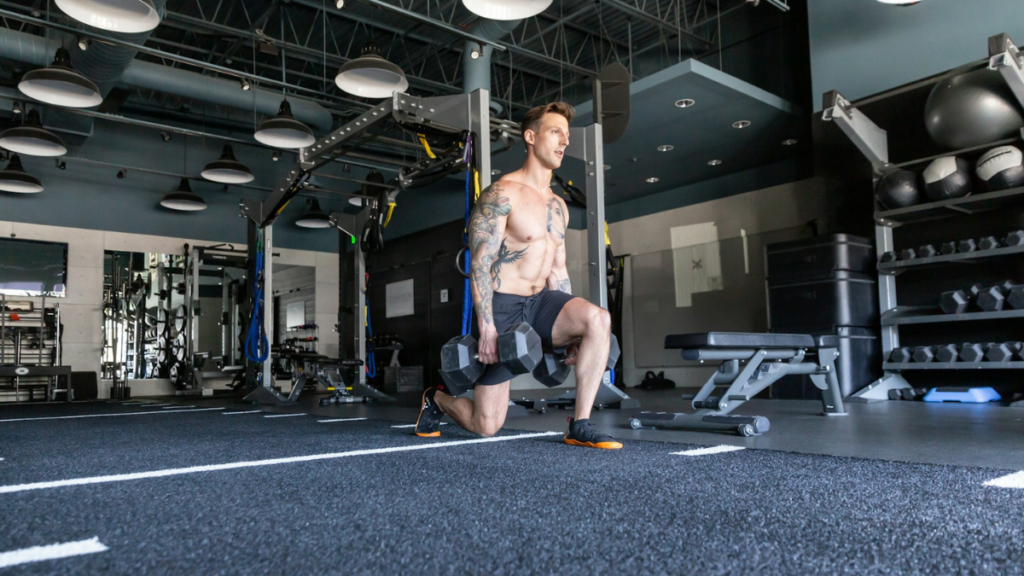
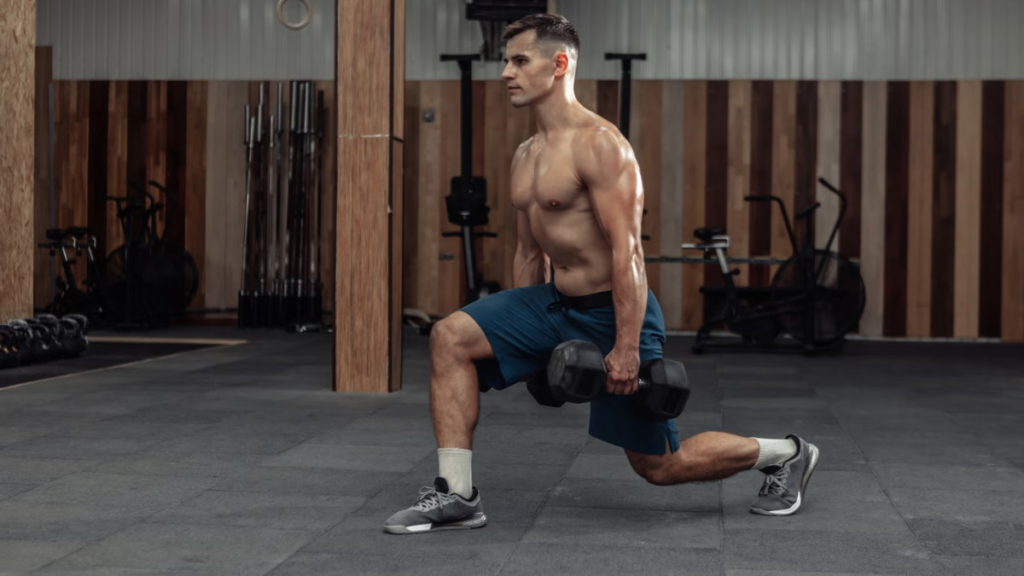
The dumbbell split squat is the most valuable unilateral exercise in this beginner routine. One foot stays in front and one foot stays behind, with both feet remaining on the floor. You lower your body by bending both knees, then push through the front foot to return to standing.
It is a simpler starting point than many people realize because the feet do not move during the set. Once you find a stable stance, you can focus on loading one leg at a time.
What Muscles Does the Dumbbell Split Squat Train?
The front leg does most of the work, especially through the quadriceps and glutes. The rear leg contributes support and balance, but it should not be the primary source of force. The split squat also challenges the muscles around the hips and trunk because they must control the pelvis while each side works independently.
Unilateral training can be useful when one leg is noticeably stronger, more coordinated, or more confident than the other. In a bilateral squat, the stronger side can sometimes contribute more without you realizing it. In a split squat, each leg receives its own set of repetitions. This does not guarantee perfectly identical legs, because human bodies are not perfectly symmetrical, but it gives each side an equal training opportunity.
Building symmetry is not about obsessing over minor visual differences. It is about ensuring that both legs can produce force and tolerate training. Start every split squat set with the side that feels less coordinated or less strong, then match that same number of repetitions on the other side.
How to Do the Dumbbell Split Squat
Begin without dumbbells if needed. Take a long enough stance that you can lower your back knee toward the floor without the front heel lifting. Keep most of your body weight over the front foot, with the rear foot acting as support.
Hold a dumbbell in each hand at your sides. Lower under control by bending both knees. Allow the front knee to move forward naturally in line with the toes. Keep the front foot planted and the torso slightly inclined forward if that feels natural and stable.
Descend until the rear knee is close to the floor or until you reach the deepest position you can control comfortably. Push through the front foot to rise. Think about driving the floor away rather than pushing aggressively from the rear toes.
Common Split Squat Mistakes
Many beginners use a stance that is too narrow. This can make the movement feel unstable and force the front heel to lift. Step the front foot farther forward until you can stay balanced through the full repetition.
Another mistake is leaning heavily into the rear leg. The back foot should help with balance, but the front leg should do most of the lifting. If you are unsure, temporarily reduce the load and slow the repetition down.
Avoid allowing the front knee to collapse inward. Keep the knee tracking in the same direction as the toes. If this is difficult, reduce the range of motion, use a lighter dumbbell, or hold onto a stable support with one hand while you learn the pattern.
How to Program It
Start with two sets of eight to 10 repetitions per leg. Split squats are demanding, so use a lighter weight than you think you need and prioritize balance. Rest for around 60 to 90 seconds before training the other leg, then take a longer rest before beginning the next round.
Once your balance improves, move to three sets per leg and gradually work toward 10 to 15 controlled repetitions. Increase the dumbbell weight only when you can keep your front foot stable, your knee tracking well, and your torso under control.
How to Build a Beginner Dumbbell Leg Workout
You can train these exercises two times per week on nonconsecutive days. This gives you regular practice while leaving enough time to recover and improve. Resistance training performed at least twice weekly is an effective starting frequency for improving muscle size and strength.
Begin with the goblet squat, because it is the most demanding bilateral movement and benefits from fresh legs. Follow with the Romanian deadlift, then finish with the split squat. This sequence trains the quads, posterior chain, and each leg individually without needlessly repeating the same pattern.
For your first few weeks, use two sets of each exercise. As your technique becomes consistent and recovery feels manageable, build toward three sets. A sensible starting session is eight to 12 goblet squats, eight to 12 Romanian deadlifts, and eight to 10 split squats per leg.
Write down the dumbbell weight and repetitions for every session. Your goal is not to set a personal record every workout. Your goal is to make steady progress over months. If you complete more repetitions with the same technique, or use a slightly heavier dumbbell while keeping the same repetitions, you are moving forward.
Eating enough total calories and protein also supports muscle growth, particularly when you are training regularly. Sleep, recovery, and regular training matter just as much as finding the perfect exercise variation. The most effective beginner leg workout is the one you can perform consistently, progress patiently, and recover from well.
The Bottom Line
You can build strong, muscular, balanced legs with a pair of dumbbells and three well chosen exercises. The goblet squat develops the quads and glutes through a beginner friendly squat pattern. The Romanian deadlift trains the hamstrings and glutes through controlled hip extension. The split squat gives each leg direct work and helps you identify meaningful differences in strength or control.
Start light enough to learn each movement properly. Use a range of motion that you can control. Train consistently, make gradual improvements, and do not rush the process. That combination will do far more for leg size and symmetry than constantly changing exercises.
References
- Currier, B.S., D’Souza, A.C., Fiatarone Singh, M.A., Lowisz, C.V., Rawson, E.S., Schoenfeld, B.J., Smith-Ryan, A.E., Steen, J.P., Thomas, G.A., Triplett, N.T., Washington, T.A., Werner, J.M. and Phillips, S.M. (2026) ‘American College of Sports Medicine Position Stand: Resistance Training Prescription for Muscle Function, Hypertrophy, and Physical Performance in Healthy Adults: An Overview of Reviews’, Medicine & Science in Sports & Exercise, 58(4), pp. 851-872.
- Grgic, J., Schoenfeld, B.J., Skrepnik, M., Davies, T.B. and Mikulic, P. (2018) ‘Effects of rest interval duration in resistance training on measures of muscular strength: A systematic review’, Sports Medicine, 48(1), pp. 137-151.
- McAllister, M.J., Hammond, K.G., Schilling, B.K., Ferreria, L.C., Reed, J.P. and Weiss, L.W. (2014) ‘Muscle activation during various hamstring exercises’, Journal of Strength and Conditioning Research, 28(6), pp. 1573-1580.
- Schoenfeld, B.J., Ogborn, D. and Krieger, J.W. (2017) ‘Dose-response relationship between weekly resistance training volume and increases in muscle mass: A systematic review and meta-analysis’, Journal of Sports Sciences, 35(11), pp. 1073-1082.
- Schoenfeld, B.J., Grgic, J., Ogborn, D. and Krieger, J.W. (2017) ‘Strength and hypertrophy adaptations between low versus high load resistance training: A systematic review and meta-analysis’, Journal of Strength and Conditioning Research, 31(12), pp. 3508-3523.
- Schoenfeld, B.J., Grgic, J., Van Every, D.W. and Plotkin, D.L. (2021) ‘Loading recommendations for muscle strength, hypertrophy, and local endurance: A re-examination of the repetition continuum’, Sports, 9(2), 32.
- Suchomel, T.J., Nimphius, S. and Stone, M.H. (2016) ‘The importance of muscular strength in athletic performance’, Sports Medicine, 46(10), pp. 1419-1449.
Key takeaways
| Exercise | Main muscles trained | Why it belongs in a beginner routine | Starting prescription |
|---|---|---|---|
| Dumbbell goblet squat | Quadriceps, glutes, adductors, trunk | Builds overall lower body size while teaching a stable, controlled squat pattern | 2 to 3 sets of 8 to 12 repetitions |
| Dumbbell Romanian deadlift | Hamstrings, glutes, trunk | Develops the posterior chain and teaches an important hip hinge pattern | 2 to 3 sets of 8 to 12 repetitions |
| Dumbbell split squat | Quadriceps, glutes, hip stabilizers | Gives each leg direct work and can reveal side to side differences in strength or control | 2 to 3 sets of 8 to 10 repetitions per leg |
| Weekly approach | Entire lower body | Train the three movements twice each week on nonconsecutive days and progress gradually | Start with two sets, then build toward three |