Building a bigger, stronger upper body does not require a complicated program or a gym full of machines. A pair of dumbbells, a bench, and a clear progression plan can take a beginner a very long way. The most useful exercises are the ones that train several major muscles at once, are practical to learn, and let you add weight or repetitions over time.
For most beginners, the priority should be building the chest, back, shoulders, and arms with balanced pushing and pulling. Resistance training can increase muscle size and strength in previously untrained adults when it is performed consistently and progressively. You do not need to train to complete failure on every set, but the working sets should feel challenging and should gradually become harder as you gain experience.


The three exercises below cover the most important upper body movement patterns. The dumbbell bench press develops the chest, shoulders, and triceps. The one arm dumbbell row builds the upper back, lats, and biceps. The seated dumbbell shoulder press trains the shoulders and triceps while improving your ability to press overhead. Together, they provide an excellent foundation for a more muscular upper body.
Why Dumbbells Are So Useful for Beginners
Dumbbells give each arm its own weight to control. This means the stronger side cannot quietly do more work for the weaker side, as it sometimes can with a barbell. They also allow the hands to move naturally rather than forcing them into one fixed position. That can make pressing exercises more comfortable for some lifters.
Dumbbells are also easy to scale. A beginner can start with light weights to learn the movement, then build strength by adding small amounts of load, adding repetitions, or improving control. Research consistently shows that progressive resistance training can improve muscular strength across a wide range of loading approaches, provided the work is sufficiently challenging and the training is repeated over time.
A muscular upper body also needs more than chest training. Pressing movements are valuable, but a well designed program should include pulling work for the back and overhead work for the shoulders. This gives you a more complete physique and helps you develop strength through different directions of movement.
The goal is not to find a magical exercise. The goal is to choose reliable movements, practice them well, and make measurable progress over months. These three dumbbell exercises make that process simple.
1. Dumbbell Bench Press
The dumbbell bench press is one of the best beginner exercises for building the chest because it combines a large range of motion with a stable position on the bench. It trains the pectoralis major, anterior deltoids, and triceps, making it an efficient upper body pushing exercise.
Why It Builds Muscle
The chest is a major contributor to horizontal pressing, while the triceps straighten the elbow and the front of the shoulder assists the movement. The dumbbell bench press challenges all three areas in one exercise. This makes it a strong choice when you want to add size to the torso without spending an entire workout on small isolation movements.
Research comparing different resistance training prescriptions shows that muscle growth can occur across a range of loads. For beginners, that means you do not need to immediately handle very heavy dumbbells. A moderate weight that allows controlled repetitions while bringing you close to muscular fatigue can be effective for building muscle.
Dumbbells also require each arm to press independently. This can expose side to side strength differences and encourages you to control the weights throughout the repetition. The movement does not need to be perfectly symmetrical at first, but smooth and controlled repetitions should become your standard.
How to Do It
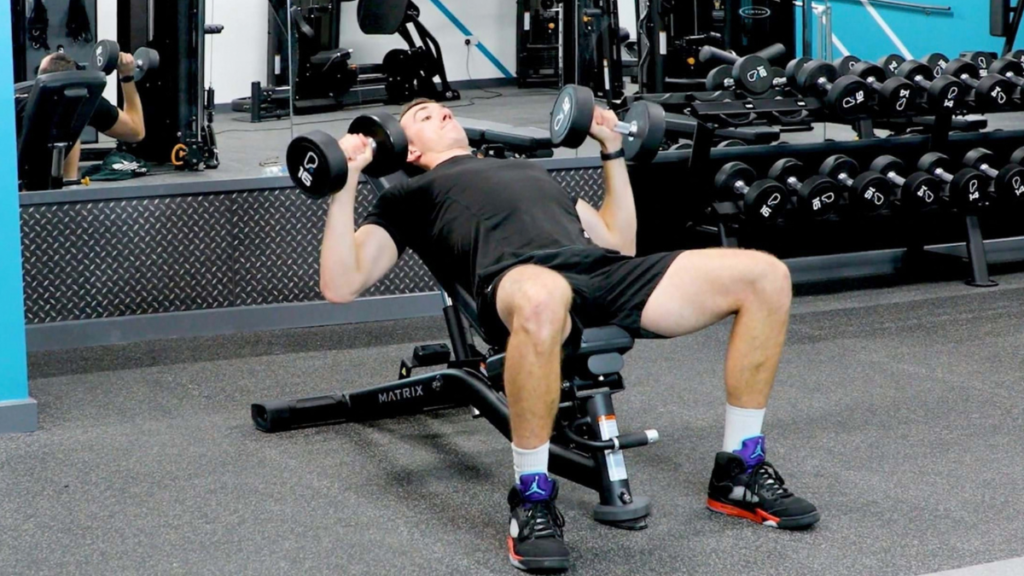
Sit on the end of a flat bench with a dumbbell resting on each thigh. Lie back while bringing the dumbbells to either side of your chest. Keep both feet firmly on the floor and create a stable base before beginning the set.
Start with your arms extended, with the dumbbells above the chest. Lower them steadily until your upper arms are close to parallel with the floor and your elbows are comfortably below the level of your torso. Press the dumbbells back up by driving the weights toward the ceiling. Keep your wrists stacked over your forearms and avoid allowing the weights to drift too far toward your face.
Your elbows should not be forced into an extreme position. A comfortable angle between the upper arms and torso usually allows you to press strongly while keeping the shoulders feeling stable. Lower the weight under control, pause briefly if needed, then press with intent.
Common Beginner Mistakes
The most common mistake is choosing dumbbells that are too heavy. If the weights drop quickly, the shoulders roll forward, or the wrists bend backward, reduce the load. A lighter dumbbell performed with control will build more useful training momentum than a heavy set with poor mechanics.
Another common problem is letting the lower back arch excessively to lift the dumbbells. Keep your feet planted and maintain a natural curve in the spine, but do not turn every repetition into a full body effort. The chest, shoulders, and triceps should be doing the main work.
Start with two or three sets of eight to twelve repetitions. When you can complete the upper end of that range with solid form, increase the dumbbell weight slightly.
2. One Arm Dumbbell Row
A jacked upper body needs a developed back. The one arm dumbbell row is a practical exercise for training the lats, upper back, rear shoulders, and biceps. It also helps beginners learn how to pull the upper arm toward the body while keeping the torso stable.
Why It Builds Muscle
The latissimus dorsi is a major back muscle that contributes to shoulder extension and adduction. It gives the torso much of its width when it is developed. Rowing movements also train muscles around the shoulder blades, including the middle trapezius and rhomboids, which help control scapular motion during pulling.
A one arm row lets you focus on one side at a time and provides support through the bench. This is useful for beginners because it reduces the balance demands compared with unsupported bent over rows. You can direct more attention toward feeling the back muscles work and maintaining a controlled path with the dumbbell.
Pulling training also balances the pressing in your program. Chest presses and shoulder presses are valuable, but rows help make sure your upper body does not become dominated by front shoulder and chest work. Regular pulling work is a key part of a balanced resistance training program.
How to Do It
Place one knee and the same side hand on a flat bench. Your other foot stays on the floor, with the dumbbell held in the opposite hand. Create a stable position with your torso roughly parallel to the floor. Keep your spine neutral and let the dumbbell hang beneath the shoulder.
Pull the dumbbell toward the side of your lower ribs or hip. Think about bringing your elbow back rather than simply curling the weight upward. Your elbow should travel close to your torso, while your shoulder stays away from your ear.
At the top of the repetition, briefly squeeze the back muscles without twisting your chest toward the ceiling. Lower the dumbbell slowly until the arm is straight and the shoulder blade can move naturally. Then repeat on the other side.
Common Beginner Mistakes
Do not turn the row into a whole body rotation. A small amount of natural movement is normal, but if your torso repeatedly opens toward the ceiling, the dumbbell is likely too heavy. Reduce the weight and aim to keep the chest facing the bench.
Avoid jerking the dumbbell off the floor position. The lowering phase matters because it contributes to the total muscular tension created during the set. Control the descent and use a full, comfortable range of motion.
Many beginners also pull the dumbbell high toward the chest. For a standard one arm row, pulling toward the lower ribs or hip often makes it easier to use the lats and keep the shoulder in a comfortable position. Perform two or three sets of eight to twelve repetitions per side.
3. Seated Dumbbell Shoulder Press
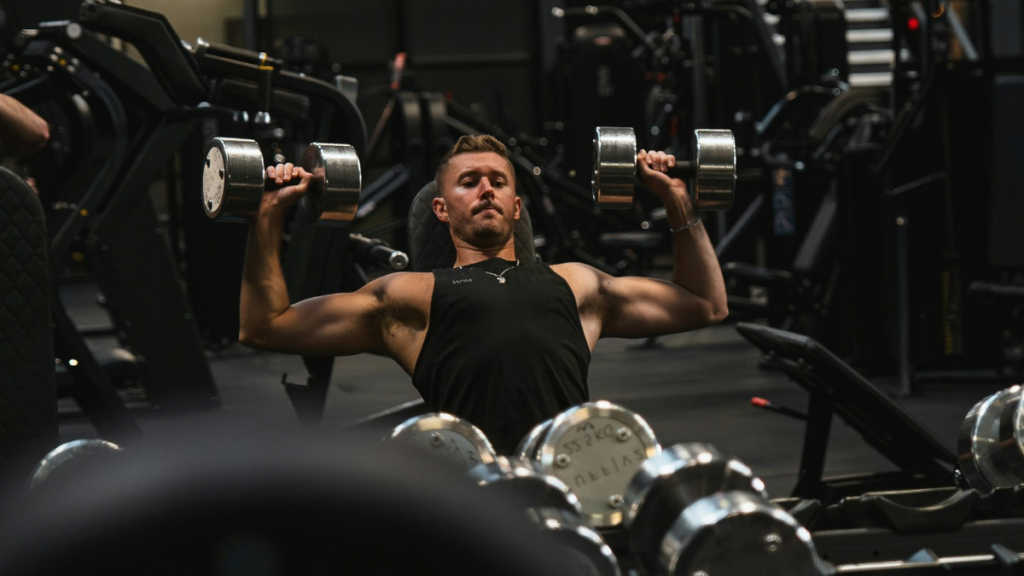
The seated dumbbell shoulder press is a straightforward way to build stronger, broader shoulders. It mainly trains the deltoids and triceps, while the upper chest and muscles that stabilize the shoulder joint contribute to the movement.
Why It Builds Muscle
The shoulder press trains an overhead pressing pattern that is not fully covered by the dumbbell bench press. While the bench press emphasizes the chest, the overhead press places greater demand on the deltoids, particularly the anterior deltoid. Research examining overhead press variations confirms that shoulder complex muscles are highly active during dumbbell pressing movements.
For a beginner focused on appearance, shoulder development matters. Wider deltoids can make the upper body look more athletic and create a stronger contrast with the waist. However, the exercise is not only aesthetic. Learning to press with control overhead develops coordination and strength that carries over to many gym movements and everyday lifting tasks.
Sitting with back support can make the movement easier to learn because it reduces the temptation to lean backward and use excessive momentum. Once you are comfortable, you can still progress for a long time simply by adding small amounts of weight or repetitions.
How to Do It
Set an adjustable bench to a near upright angle. Sit with your back supported and both feet firmly on the floor. Begin with the dumbbells around shoulder height, with your forearms close to vertical.
Press the dumbbells upward until your arms are extended overhead. You do not need to force the dumbbells to collide at the top. Keep them controlled and allow your arms to finish in a position that feels strong and comfortable.
Lower the dumbbells steadily back to shoulder level. Keep your ribs down and avoid dramatically arching your lower back. Your head should remain neutral rather than pushing far forward as the dumbbells rise.
A neutral grip, with the palms facing each other, is a perfectly good option if it feels more comfortable for your shoulders. There is no need to copy another person’s exact hand position if a small adjustment improves your control and comfort.
Common Beginner Mistakes
The biggest mistake is leaning back to turn the shoulder press into an incline chest press. Keep your back against the pad and lower the weight if you cannot maintain that position. The aim is to challenge the shoulders, not to find a way around them.
Another mistake is lowering the dumbbells too quickly or too deeply. Use a range of motion that allows your shoulders to feel stable and pain free. Resistance training discomfort from muscular effort is normal, but sharp joint pain is a sign to stop and reassess the exercise, technique, or load.
Start with two or three sets of eight to twelve repetitions. As with the other exercises, increase the load only when your repetitions remain controlled from start to finish.
How to Turn These Three Exercises Into a Beginner Workout
Perform this workout two or three times per week, with at least one day between sessions. Begin each exercise with a light warm up set so you can practice the movement and judge whether the working weight is appropriate.
3 Best Beginner Cable Exercises for Building a More Muscular Back
Use a load that allows you to complete eight to twelve controlled repetitions while feeling that you could perform roughly one to three more repetitions at the end of the set. You do not need to reach failure every time. Research indicates that resistance training can build muscle when sets are performed close to failure, while constantly training to absolute failure is not required for progress.
Start with two sets of each exercise if you are new to lifting or returning after a long break. Progress to three sets when you can recover well and your form stays consistent. Rest for around two minutes between sets, especially after pressing movements. Longer rest periods can help preserve repetition quality and total training volume.
Track your workouts. Write down the dumbbell weight and repetitions for each exercise. Your goal is to gradually earn the right to use more weight. For example, if you complete three sets of twelve repetitions with the same dumbbells and clean form, try a slightly heavier pair next session. If the heavier weight reduces your repetitions, that is normal. Build them back up over the following weeks.
Eat enough protein, sleep adequately, and give your body time to adapt. Resistance training provides the stimulus, but recovery supports the growth process. Consistency will matter far more than trying to destroy yourself in one workout.
The Bottom Line
The dumbbell bench press, one arm dumbbell row, and seated dumbbell shoulder press give beginners a simple and effective route to a more muscular upper body. They train the chest, back, shoulders, and arms through the movements that matter most.
Master the technique, choose weights you can control, and make gradual progress. You do not need endless exercise variety to build an impressive physique. You need a few dependable movements, enough hard sets, and the patience to repeat them consistently.
References
- American College of Sports Medicine (2026) ‘Resistance training prescription for muscle function, hypertrophy, and physical performance in healthy adults: An overview of reviews’, Medicine & Science in Sports & Exercise, 58(4), pp. 633–650.
- Grgic, J., Schoenfeld, B.J., Orazem, J. and Sabol, F. (2022) ‘Effects of resistance training performed to repetition failure or non failure on muscular strength and hypertrophy: A systematic review and meta analysis’, Journal of Sport and Health Science, 11(2), pp. 202–211.
- Kosuge, T., Mitsuya, H., Hakkaku, T., Okamura, S. and Okada, T. (2026) ‘Electromyographic activity during bench press differs by attentional focus strategy and sport: A cross sectional comparison of bodybuilding, powerlifting, and paralympic powerlifting’, European Journal of Applied Physiology, 126(6), pp. 3139–3156.
- Krieger, J.W. (2010) ‘Single versus multiple sets of resistance exercise for muscle hypertrophy: A meta analysis’, Journal of Strength and Conditioning Research, 24(4), pp. 1150–1159.
- Mota, J.A., Nuckols, G., Smith-Ryan, A.E., Dalbo, V.J., Miller, P.E., Apicella, J.M., Ormsbee, M.J., Galpin, A.J. and Willoughby, D.S. (2022) ‘The dose response association between resistance training volume and muscle hypertrophy: Systematic review and meta analysis’, Sports Medicine, 52(9), pp. 2167–2182.
- Schoenfeld, B.J., Grgic, J., Van Every, D.W. and Plotkin, D.L. (2021) ‘Loading recommendations for muscle strength, hypertrophy, and local endurance: A re examination of the repetition continuum’, Sports, 9(2), 32.
- Schoenfeld, B.J., Ogborn, D. and Krieger, J.W. (2016) ‘Effects of resistance training frequency on measures of muscle hypertrophy: A systematic review and meta analysis’, Sports Medicine, 46(11), pp. 1689–1697.
- Stastny, P., Lehman, G., Tufano, J.J., Cizkova, I. and Golas, A. (2017) ‘A comparison of dumbbell and barbell bench press exercises’, Journal of Strength and Conditioning Research, 31(7), pp. 1879–1884.
- Sushko, R., Buskard, A.N., Katalinic, O.M. and Dufek, J.S. (2024) ‘Electromyographic analysis of shoulder complex muscles performing overhead presses with dumbbell, kettlebell, and bottom up kettlebell’, Journal of Strength and Conditioning Research, 38(10), pp. 1797–1803.
Key Takeaways
| Exercise | Main muscles trained | Beginner target | Main coaching point |
|---|---|---|---|
| Dumbbell bench press | Chest, front shoulders, triceps | 2 to 3 sets of 8 to 12 repetitions | Lower with control and keep the wrists stacked over the forearms |
| One arm dumbbell row | Lats, upper back, rear shoulders, biceps | 2 to 3 sets of 8 to 12 repetitions per side | Pull the elbow toward the hip without twisting the torso |
| Seated dumbbell shoulder press | Shoulders, triceps, upper chest | 2 to 3 sets of 8 to 12 repetitions | Keep the back supported and avoid leaning backward |
| Progression | Entire upper body | Add repetitions, then small amounts of weight | Make changes only when every repetition remains controlled |