

Building bigger biceps does not require a secret rep range, endless curl variations, or punishing every set until your arms stop working. For beginners, the most productive approach is to use a moderate range of repetitions with sound technique, enough effort, and steady progression over time.
The most useful starting point is usually 8 to 15 repetitions per set for direct biceps work. This range is heavy enough to teach you how to produce force and progressively add load, while still allowing enough repetitions to practice the movement and keep technique under control. It is not the only effective range for muscle growth, but it is particularly practical when you are new to lifting.


Research shows that muscles can grow across a broad spectrum of loads and rep ranges when sets are performed with sufficient effort. The rep range you choose still matters because it affects exercise technique, joint comfort, the amount of weight you can use, and how easily you can progress. For beginners who want noticeably larger arms, those practical factors matter a great deal.
Why Rep Ranges Matter for Biceps Growth
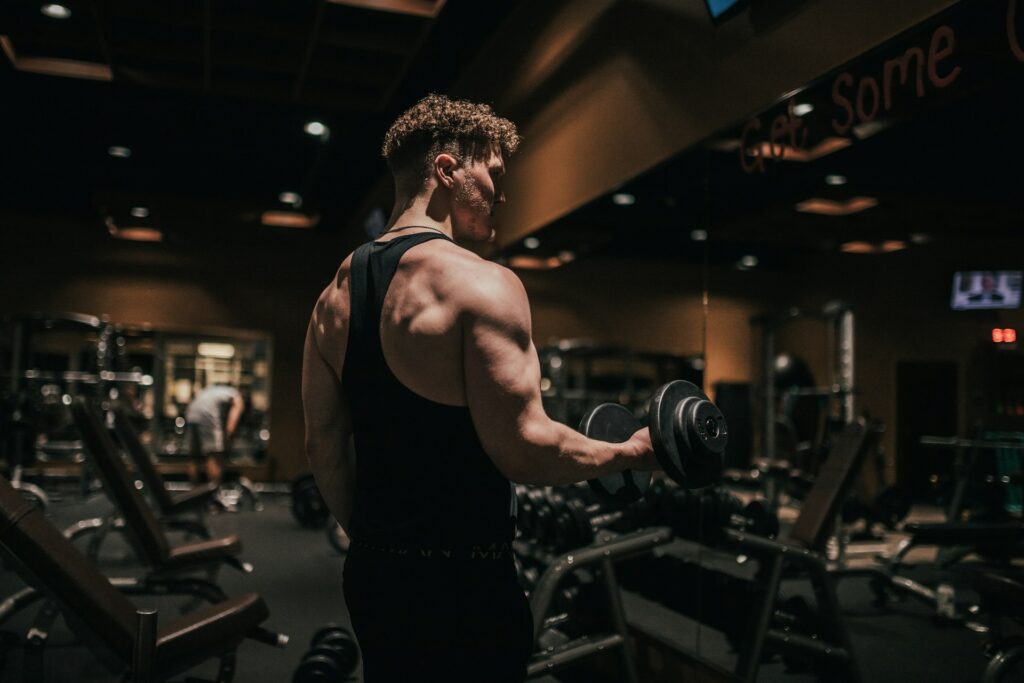
A repetition is one complete movement of an exercise. In a dumbbell curl, it begins with the elbow straight, continues as you curl the weight upward, and finishes when you lower it under control. A rep range is simply the target number of repetitions you complete in each set.
The number of reps you perform is tied to the weight you use. Heavier weights usually limit you to fewer reps, while lighter weights allow more reps. Both can stimulate hypertrophy, which is the increase in muscle size, but they create different training experiences.
When you train in very low rep ranges, such as 3 to 6 reps, the weights are comparatively heavy. This can be useful for building strength, but it requires good control and can make it harder for a beginner to keep the upper arm still during curls. It is also difficult to safely take very heavy curls close to the effort needed for maximal muscle growth without turning the movement into a swinging exercise.
Very high rep sets, such as 20 to 30 reps, can build muscle too. However, they produce considerable local fatigue and discomfort. Beginners often mistake that burning sensation for high quality training and allow form to deteriorate. The result is frequently more movement from the shoulders, hips, and lower back than from the elbow flexors.
Moderate rep work offers a useful middle ground. It lets you train hard enough to challenge the biceps while keeping the load manageable and the movement repeatable. This makes it easier to learn what a strict curl should feel like and gives you a clear path for progression.
The Best Starting Rep Range: 8 to 15 Repetitions
For most beginners, performing direct biceps exercises for 8 to 15 controlled repetitions is an excellent place to start. Aim to select a weight that allows you to finish the set with one to three repetitions still possible while maintaining strict form.
This does not mean every set must stop at exactly 10 or 12 repetitions. A rep range gives you room to improve. For example, you might begin a dumbbell curl with a weight you can use for 8 reps. Over several sessions, you work toward 9, 10, 11, and then 12 reps with the same form. Once you can reach the upper end of the range on every working set, increase the weight slightly and begin again closer to the lower end.

This approach is often called double progression. It is simple, measurable, and especially useful for beginners because it prevents random changes in training. Instead of adding weight whenever you feel strong, you earn the increase by demonstrating that you can control the current weight for more repetitions.
A large body of research indicates that hypertrophy can occur with both lighter and heavier loads when effort is sufficiently high. However, heavier loading tends to produce larger improvements in maximal strength. For a beginner focused on building biceps, moderate reps provide a productive blend of muscle building stimulus, skill development, and strength progress.
How Close Should You Train to Failure?
Training to failure means you cannot complete another repetition with proper technique. It is not necessary to hit failure on every curl set to build bigger biceps. In fact, regularly forcing every set to failure can create fatigue that makes the rest of your session less productive.
A better beginner target is to finish most sets with about one to three repetitions in reserve. This means you feel that you could probably perform one, two, or three more clean repetitions if you had to. The weight should still feel challenging near the end of the set. If you complete 15 curls and feel as though you could easily do another 10, the load is too light for the purpose of that set.
Keeping a small amount in reserve is valuable because it protects technique. Biceps curls are simple in theory, but they are easy to cheat when fatigue rises. If your torso rocks backward, your elbows drift far forward, or the dumbbells are thrown upward, the biceps are no longer doing as much of the work.
Research comparing failure and nonfailure training suggests that both approaches can support increases in muscle size when total training is appropriately structured. For a beginner, the ability to repeat high quality sets and recover for the next session is more important than making every set feel maximal.
Use Different Rep Ranges Across the Week
The 8 to 15 range should be your foundation, not a restriction. Once you have learned strict curl technique, using more than one rep range can make training more enjoyable and help you develop strength alongside muscle size.
One simple option is to use a slightly heavier exercise for 6 to 10 reps and a more stable exercise for 10 to 15 reps. For example, you could use standing barbell curls for 6 to 10 reps, then use cable curls or incline dumbbell curls for 10 to 15 reps. The heavier movement develops your ability to handle load, while the moderate repetition movement gives you more controlled practice and focused work for the biceps.
You can also occasionally use 15 to 20 repetitions on a cable curl or machine curl. These exercises are often easier to control than free weight curls and can be a comfortable way to add training volume without relying on very heavy weights. The important point is to keep the movement strict and finish the set close enough to fatigue that the biceps receive a meaningful stimulus.
Do not feel compelled to use every rep range in the same workout. Beginners often make training complicated before they have mastered the basics. Two or three exercises performed consistently with good form will outperform a constantly changing routine built around novelty.
The Right Number of Sets for Beginners
Rep ranges are only one part of the program. Your total number of challenging sets matters too. A set needs to be sufficiently difficult and performed with enough control to count as useful biceps work.
As a beginner, start with approximately 6 to 10 direct sets for biceps per week, spread across two sessions. This could mean three sets of curls after upper body training on two days each week, plus a few additional sets from another curl variation. Pulling exercises such as rows and pulldowns also involve the biceps, but direct curl work is useful if arm growth is a clear goal.
Beginning with a manageable amount of work helps you recover and learn the exercises properly. More volume can support greater muscle growth, but only if you can maintain performance and recover between sessions. Jumping immediately to a very high number of sets can leave your elbows sore, reduce the quality of your training, and make it harder to know what is actually working.
After several weeks, assess your progress. If your technique is improving, your reps or loads are increasing, and your elbows feel good, you may add a small amount of work. One or two extra weekly sets is enough. Building muscle is a long term process, so there is no advantage in rushing into more volume than you can recover from.
Choose Exercises That Let You Keep the Tension on Your Biceps
The best rep range will not rescue a poorly chosen exercise or poor execution. Choose curls that allow you to work the biceps through a comfortable range of motion without needing momentum.
Standing dumbbell curls are a strong starting point because each arm works independently and the resistance can be adjusted in small increments. Alternating arms can also make the set easier to control and lets you focus on keeping the shoulder quiet.
Cable curls are another excellent choice because they provide consistent resistance throughout much of the movement. They are especially useful for higher rep work, such as 12 to 20 reps, because the resistance remains predictable and the setup can make cheating less tempting.
Incline dumbbell curls train the elbow flexors with the arm positioned behind the torso. This position can feel demanding, so use a conservative load and focus on a controlled lowering phase. Preacher curls can help limit body movement, but they should also be performed with care and a comfortable range of motion. Avoid aggressively forcing the elbow straight at the bottom of the movement.
All curl variations should include a deliberate lowering phase. Resistance training research supports the importance of effort and progressive overload, while controlled repetitions make it easier to apply those principles consistently. Lower the weight under control, rather than allowing gravity to do the work, and use a range of motion that is comfortable for your elbows and wrists.
A Simple Beginner Biceps Plan
Train your biceps twice each week, leaving at least one day between direct biceps sessions when possible. Begin with a small number of exercises and use the same movements long enough to become proficient.
In the first session, perform three sets of dumbbell curls for 8 to 12 repetitions. Follow them with two sets of cable curls for 12 to 15 repetitions. Use a load that leaves one to three repetitions in reserve on most sets.
In the second session, perform three sets of barbell curls or EZ bar curls for 6 to 10 repetitions. Then complete two sets of incline dumbbell curls for 10 to 15 repetitions. If the incline curl bothers your shoulders or elbows, replace it with another cable or dumbbell curl variation that feels comfortable.
This gives you 10 direct weekly sets. It is enough to create a clear training signal for many beginners without turning arm training into an exhausting marathon. Keep a record of your weight and repetitions. Your goal is to gradually perform more repetitions with the same weight or use slightly more weight while staying within the target range.
Common Mistakes That Limit Biceps Growth
The first mistake is treating the weight as the goal. The biceps do not know the number written on the dumbbell. They respond to tension, effort, and repeated exposure to progressively challenging training. If a heavier weight forces you to swing your torso and shorten the range of motion, it may be less effective than a lighter weight performed with control.
The second mistake is using only one rep target forever. Staying within 8 to 15 reps works well, but occasional periods of heavier 6 to 10 rep work and lighter 15 to 20 rep work can make your training more adaptable. You do not need constant variety, but a small amount can help you keep progressing.

The third mistake is adding exercises before improving performance. You do not need six different curl variations in one session. Pick a few movements, practice them, and track them. Better technique, more repetitions, or a modest load increase are all meaningful signs of progress.
Blow Up Your Pecs Using These 3 Exercises in the Gym
The final mistake is ignoring recovery. Muscle growth is supported by resistance training, adequate dietary protein, sufficient energy intake, and sleep. If your training improves but your body weight, recovery, and nutrition are inconsistent, your progress may be slower than expected. Resistance training provides the stimulus, but the body needs resources and time to adapt.
The Bottom Line
The best rep range for beginners who want massive biceps is usually 8 to 15 repetitions per set. It combines enough load to develop strength with enough repetition practice to learn strict technique and accumulate quality training volume.
Use a weight that makes the final few reps challenging while leaving one to three repetitions in reserve. Train your biceps directly around twice per week, begin with about 6 to 10 challenging weekly sets, and progress gradually. As your technique and confidence improve, include some work in the 6 to 10 and 15 to 20 rep ranges for variety and continued development.
The biggest biceps gains will not come from chasing a single magic number. They will come from doing controlled curls consistently, applying progressive overload, recovering well, and giving the process enough time.
References
- Currier, B.S., McLeod, J.C., Banfield, L., Beyene, J., Welton, N.J., D’Souza, A.C., Keogh, J.A., Lin, L., Coletta, G., Yang, A., Colenso-Semple, L., Lau, K.J., Verboom, A. and Phillips, S.M. (2023) ‘Resistance training prescription for muscle strength and hypertrophy in healthy adults: a systematic review and Bayesian network meta analysis’, British Journal of Sports Medicine, 57(18), pp. 1211–1220. doi: 10.1136/bjsports-2023-106807.
- Grgic, J., Schoenfeld, B.J., Orazem, J., Sabol, F., Smajić, M., Bishop, D.J. and Pedisic, Z. (2022) ‘Effects of resistance training performed to repetition failure or nonfailure on muscular strength and hypertrophy: a systematic review and meta analysis’, Journal of Sport and Health Science, 11(2), pp. 202–211. doi: 10.1016/j.jshs.2021.01.007.
- Schoenfeld, B.J., Grgic, J., Ogborn, D. and Krieger, J.W. (2017) ‘Strength and hypertrophy adaptations between low versus high load resistance training: a systematic review and meta analysis’, Journal of Strength and Conditioning Research, 31(12), pp. 3508–3523. doi: 10.1519/JSC.0000000000002200.
- Schoenfeld, B.J., Ogborn, D. and Krieger, J.W. (2017) ‘Dose response relationship between weekly resistance training volume and increases in muscle mass: a systematic review and meta analysis’, Journal of Sports Sciences, 35(11), pp. 1073–1082. doi: 10.1080/02640414.2016.1210197.
- Schoenfeld, B.J., Ogborn, D. and Krieger, J.W. (2019) ‘Effects of resistance training frequency on measures of muscle hypertrophy: a systematic review and meta analysis’, Sports Medicine, 49(9), pp. 1359–1371. doi: 10.1007/s40279-019-01101-0.
- Schoenfeld, B.J., Contreras, B., Vigotsky, A.D. and Peterson, M. (2016) ‘Differential effects of heavy versus moderate loads on measures of strength and hypertrophy in resistance trained men’, Journal of Sports Science and Medicine, 15(4), pp. 715–722.
- Wernbom, M., Augustsson, J. and Thomeé, R. (2007) ‘The influence of frequency, intensity, volume and mode of strength training on whole muscle cross sectional area in humans’, Sports Medicine, 37(3), pp. 225–264. doi: 10.2165/00007256-200737030-00004.
Key takeaways
| Focus | Beginner recommendation | Why it works |
|---|---|---|
| Primary rep range | 8 to 15 repetitions per set | It balances manageable loading, high quality technique, and productive muscle building effort. |
| Effort level | Finish most sets with 1 to 3 repetitions in reserve | This keeps sets hard enough for growth while helping protect form and recovery. |
| Weekly direct biceps volume | Start with 6 to 10 challenging sets | It provides a useful stimulus without overwhelming a new lifter’s recovery capacity. |
| Training frequency | Train biceps directly twice each week | Splitting work across two sessions helps maintain set quality and creates regular practice. |
| Progression | Add reps first, then add a small amount of weight | This provides a simple and reliable way to create progressive overload. |
| Useful variety | Include occasional 6 to 10 and 15 to 20 rep sets | Different loading ranges can support continued strength and muscle development. |