

Building stronger biceps in 30 days is realistic if you approach training with the right mix of science, consistency, and recovery. The biceps brachii is a relatively small muscle group, but it responds quickly to progressive overload, proper nutrition, and targeted programming. This article breaks down exactly how to do it in a clear, evidence based way.
Understanding the Biceps Muscle
The biceps brachii has two heads, the long head and the short head. Both originate at the shoulder and attach to the forearm. This dual structure allows the biceps to perform several key actions:


- Elbow flexion, which means bending the arm
- Forearm supination, which means turning the palm upward
- Assistance in shoulder flexion
The brachialis and brachioradialis also play important roles in elbow flexion. Many people focus only on the visible biceps peak, but true strength development requires training all these muscles.

Muscle growth occurs when fibers experience mechanical tension, metabolic stress, and muscle damage. Resistance training stimulates these processes, leading to hypertrophy and increased strength over time.
The Science of Building Strength in 30 Days
Thirty days is a short time frame, but measurable improvements are possible due to neural adaptations. Early strength gains are largely driven by improved motor unit recruitment and coordination rather than pure muscle growth.
Research shows that:
- Strength gains can occur within the first two to four weeks of training
- Training frequency of two to three sessions per week per muscle group is effective
- Progressive overload is the key driver of strength improvement
Hypertrophy also begins within this period, especially in beginners or those returning after a break. Muscle protein synthesis increases after resistance training and remains elevated for up to 48 hours.
Principles for Rapid Biceps Strength Gains
To maximize results in 30 days, focus on these core principles.
Progressive Overload
You must gradually increase the demand placed on the muscles. This can be done by:
- Increasing weight
- Increasing repetitions
- Improving technique
- Reducing rest time
Without progression, the body adapts and stops improving.
Training Volume
Volume refers to sets multiplied by reps multiplied by load. Research suggests that moderate to high volume is effective for hypertrophy.
A practical target for biceps is:
- 10 to 20 total sets per week
Training Frequency
Training a muscle more than once per week leads to better outcomes than once weekly sessions. Aim for:
- 2 to 3 biceps focused sessions per week

Exercise Selection
Use a mix of compound and isolation exercises.
Compound movements:
- Pull ups
- Chin ups
- Rows
Isolation movements:
- Barbell curls
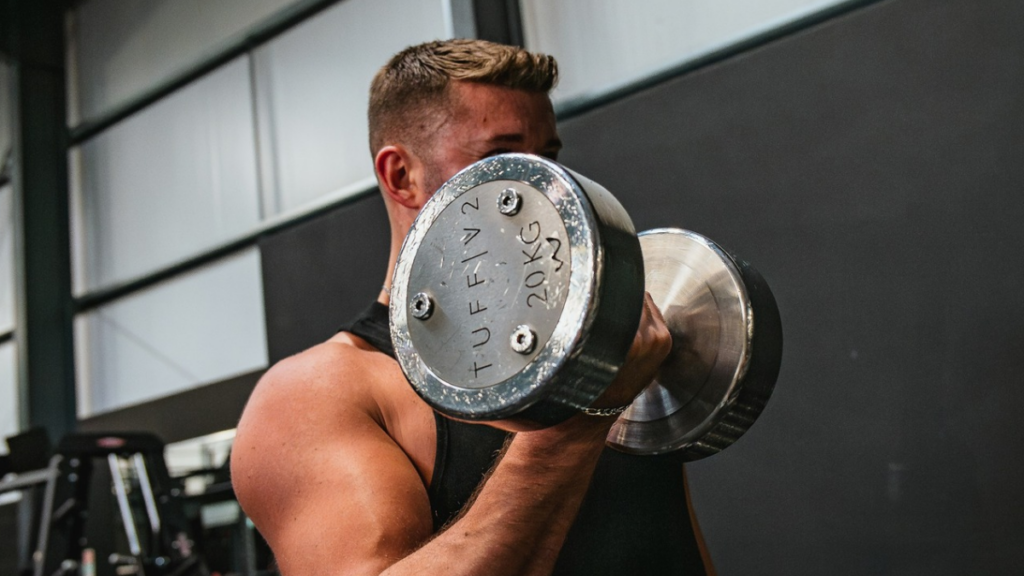
- Dumbbell curls
- Cable curls
Time Under Tension
Slowing down the eccentric phase increases muscle activation and growth stimulus. Aim for controlled reps rather than rushing.
The Best Exercises for Biceps Strength
Barbell Curl
This is a foundational movement for building strength.
Key points:
- Keep elbows close to the body
- Avoid swinging
- Use full range of motion
Dumbbell Curl
Allows unilateral training and corrects imbalances.
Variations include:
- Alternating curls
- Hammer curls
- Incline curls
Chin Ups
One of the most effective compound exercises for biceps. Use an underhand grip and focus on controlled movement.
Cable Curl
Provides constant tension throughout the movement. This is useful for maximizing muscle activation.
Preacher Curl
Isolates the biceps and reduces momentum. This helps improve strict strength.
The 30 Day Biceps Strength Plan
This program is designed for four weeks. Train biceps three times per week with at least one rest day between sessions.
Weekly Structure
- Day 1: Heavy strength focus
- Day 2: Moderate hypertrophy focus
- Day 3: Volume and pump focus
Week 1 and Week 2
Focus on learning technique and building a base.
Day 1:
- Barbell curls: 4 sets of 6 reps
- Chin ups: 4 sets of 6 to 8 reps
- Hammer curls: 3 sets of 10 reps
Day 2:
- Incline dumbbell curls: 3 sets of 10 reps
- Cable curls: 3 sets of 12 reps
- Preacher curls: 3 sets of 10 reps
Day 3:
- Light barbell curls: 3 sets of 12 reps
- Resistance band curls: 3 sets of 15 reps
- Isometric hold at peak contraction: 3 sets of 20 seconds
Week 3 and Week 4
Increase intensity and volume.
Day 1:
- Barbell curls: 5 sets of 5 reps
- Weighted chin ups: 4 sets of 5 to 6 reps
- Hammer curls: 4 sets of 8 reps
Day 2:
- Incline dumbbell curls: 4 sets of 8 reps
- Cable curls: 4 sets of 10 reps
- Preacher curls: 3 sets of 8 reps
Day 3:
- Drop set curls: 3 rounds
- High rep cable curls: 3 sets of 15 reps
- Isometric holds: 3 sets of 30 seconds
Progress by increasing weight when you can complete all reps with good form.
The Role of Nutrition in Biceps Strength
Strength gains require adequate nutrition. Without it, training alone is not enough.

Protein Intake
Protein provides the building blocks for muscle repair and growth. Research supports:
- 1.6 to 2.2 grams of protein per kilogram of body weight per day
Good sources include:
- Lean meats
- Eggs
- Dairy
- Plant based proteins
Caloric Intake
To build strength, you need enough energy.
- A slight calorie surplus supports muscle growth
- Maintenance calories can still yield strength gains, especially for beginners
Timing
Consuming protein after training supports muscle protein synthesis. A practical approach:
- 20 to 40 grams of protein within a few hours after training
Hydration
Dehydration reduces performance and recovery. Aim for consistent fluid intake throughout the day.
Recovery and Sleep
Recovery is where adaptation happens.
Sleep
Sleep is critical for muscle recovery and hormone regulation.
Research shows:
- 7 to 9 hours per night supports optimal performance and recovery
Lack of sleep reduces strength and increases injury risk.
Rest Days
Muscles need time to repair. Training the same muscle every day can reduce progress. Include at least one rest day between biceps sessions.
Active Recovery
Light activity such as walking or mobility work can improve blood flow and recovery.
Common Mistakes That Limit Progress
Using Too Much Weight
Poor form reduces muscle activation and increases injury risk. Focus on controlled movements.
Neglecting Compound Exercises
Isolation work alone is not enough. Compound movements provide greater overall stimulus.
Inconsistent Training
Skipping sessions breaks the progression cycle. Consistency is essential for 30 day results.
Ignoring Recovery
Overtraining leads to fatigue and reduced performance. Balance training with rest.

Supplements That May Help
Supplements are not required, but some can support performance.
Creatine Monohydrate
One of the most researched supplements.
Benefits include:
- Increased strength
- Improved training performance
Protein Powder
Convenient way to meet protein needs.
Caffeine
Can improve focus and performance during workouts. Use in moderation.
Tracking Your Progress
To ensure improvement, track your training.
Record:
- Weights used
- Repetitions completed
- Perceived effort
You should see gradual increases over the 30 days. Taking progress photos and measuring arm circumference can also help track changes.
Expected Results After 30 Days
Results vary based on experience level.
Beginners may see:
- Noticeable strength gains
- Slight increase in muscle size
Intermediate lifters may see:
- Improved lifting capacity
- Better muscle definition
Even small improvements are meaningful in such a short time frame.
Final Thoughts
Strengthening your biceps in 30 days is achievable with a focused plan, consistent training, and proper recovery. The key is to follow evidence based principles and avoid shortcuts.
Stick to progressive overload, train multiple times per week, eat enough protein, and prioritize sleep. These fundamentals will not only improve your biceps but also set the foundation for long term progress.
Key Takeaways
| Topic | Key Point |
|---|---|
| Training Frequency | Train biceps 2 to 3 times per week for best results |
| Volume | Aim for 10 to 20 sets per week |
| Progressive Overload | Gradually increase weight or reps each week |
| Exercise Selection | Combine compound and isolation exercises |
| Protein Intake | Consume 1.6 to 2.2 grams per kilogram of body weight |
| Recovery | Sleep 7 to 9 hours per night |
| Program Duration | Follow a structured 4 week plan |
| Expected Results | Strength gains and early hypertrophy within 30 days |
References
- American College of Sports Medicine (2009). Progression models in resistance training for healthy adults. Medicine and Science in Sports and Exercise, 41(3), pp. 687 to 708.
- Schoenfeld, B.J. (2010). The mechanisms of muscle hypertrophy and their application to resistance training. Journal of Strength and Conditioning Research, 24(10), pp. 2857 to 2872.
- Schoenfeld, B.J., Ogborn, D. and Krieger, J.W. (2016). Effects of resistance training frequency on measures of muscle hypertrophy. Sports Medicine, 46(11), pp. 1689 to 1697.
- Morton, R.W. et al. (2018). A systematic review of protein supplementation on resistance training induced gains. British Journal of Sports Medicine, 52(6), pp. 376 to 384.
- Phillips, S.M. and Van Loon, L.J.C. (2011). Dietary protein for athletes. Journal of Sports Sciences, 29(sup1), pp. S29 to S38.
- Grgic, J. et al. (2018). Effects of resistance training performed to repetition failure or non failure on muscular strength and hypertrophy. Journal of Sport and Health Science, 7(1), pp. 1 to 7.
- Candow, D.G. and Chilibeck, P.D. (2007). Effect of creatine supplementation during resistance training. Journal of Strength and Conditioning Research, 21(4), pp. 1322 to 1327.