

Training at home has gone from a temporary solution to a long term strategy for millions of people. Whether you are short on time, prefer privacy, or simply want to avoid crowded gyms, home strength workouts can deliver impressive results when done correctly. The key is not having the most equipment, but understanding how strength adaptations actually work and applying that knowledge in a smart, consistent way.
This article breaks down three science backed tips that will help you build strength effectively at home. Each tip is grounded in research from exercise physiology and strength training science, and translated into practical steps you can apply right away.


Why Home Strength Training Works
Before diving into the tips, it is important to understand a simple truth. Your muscles do not know whether you are training in a gym or your living room. What they respond to is tension, fatigue, and progressive overload.
Strength gains come from a combination of neural adaptations and muscle hypertrophy. Early improvements in strength are largely driven by the nervous system becoming more efficient at recruiting muscle fibers. Over time, increases in muscle size contribute more to strength development.
Research consistently shows that resistance training, even with minimal equipment, can produce significant improvements in strength and muscle mass when key variables are controlled properly. These variables include intensity, volume, frequency, and progression. With that in mind, let us look at the three most important tips.
Tip 1: Focus on Progressive Overload

What Progressive Overload Really Means
Progressive overload is the gradual increase of stress placed on the body during exercise. This is the single most important principle for building strength. Without it, your body has no reason to adapt.
In a gym, progressive overload often means adding weight to a barbell. At home, it requires a bit more creativity, but the principle stays exactly the same.
Scientific studies show that muscles grow and get stronger when they are challenged beyond their current capacity. This can be achieved not only by increasing load, but also by manipulating other variables such as repetitions, time under tension, and training density.
How to Apply It at Home
Even with limited equipment, you have many ways to progressively overload your workouts:
• Increase repetitions while keeping the same exercise
• Slow down the tempo to increase time under tension
• Reduce rest time between sets
• Add pauses in challenging positions
• Increase range of motion
• Perform unilateral variations such as single leg or single arm movements
• Add external load using backpacks, resistance bands, or household objects
For example, if you are doing push ups, you can progress from knee push ups to standard push ups, then to elevated feet push ups, and eventually to single arm variations. Each step increases the demand on your muscles.
The Science Behind It
Research has shown that muscle hypertrophy can occur across a wide range of loads as long as sets are taken close to muscular failure. This means you do not need heavy weights to build strength. What matters is that the muscle is sufficiently challenged.
Another key finding is that progressive overload must be consistent. Random workouts without a plan will not produce optimal results. Tracking your performance, even in simple ways such as writing down reps or sets, can significantly improve progress.
Common Mistakes to Avoid
Many people training at home fall into the trap of doing the same workout repeatedly without progression. This leads to plateaus.
Another mistake is pushing to failure too often without proper recovery. While training close to failure is effective, doing it in every set can increase fatigue and reduce overall performance.
The goal is to gradually increase difficulty over time while maintaining good form and consistency.
Tip 2: Prioritize Compound Movements
Why Compound Exercises Matter
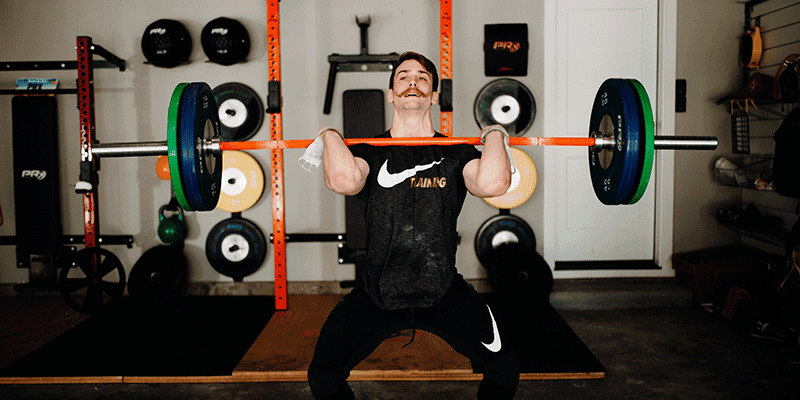
Compound movements are exercises that involve multiple joints and muscle groups. Examples include squats, push ups, lunges, and rows. These exercises are highly effective for building strength because they allow you to train more muscle mass at once. They also mimic real world movement patterns, which improves functional strength.
Scientific evidence shows that compound exercises lead to greater overall strength gains compared to isolation movements when total training volume is similar. They also produce higher levels of muscle activation and hormonal responses.
Essential Compound Movements for Home Workouts
You can build a complete strength program at home using just a few key movement patterns:
• Squat pattern such as bodyweight squats or split squats
• Hinge pattern such as hip thrusts or Romanian deadlifts with minimal load
• Push pattern such as push ups or dips
• Pull pattern such as inverted rows or resistance band rows
• Core stabilization such as planks and anti rotation exercises
Each of these patterns targets major muscle groups and contributes to overall strength.
How to Structure Your Training
A simple and effective approach is to build workouts around these movement patterns. For example:
• Lower body focus day with squats, lunges, and hip hinges
• Upper body focus day with push and pull exercises
• Full body sessions that combine all patterns
Research suggests that training each muscle group at least two times per week is effective for strength and hypertrophy. This can be achieved with full body workouts or split routines.
The Role of Volume and Intensity
Training volume refers to the total amount of work performed, usually measured as sets multiplied by repetitions. Intensity refers to how hard the exercise is relative to your maximum capacity.
Studies indicate that moderate to high training volume combined with sufficient intensity produces the best results. For home training, this often means performing multiple sets of each compound exercise and working close to fatigue.
Common Mistakes to Avoid
A common mistake is focusing too much on small muscle groups while neglecting compound movements. This leads to inefficient training and slower progress.
Another issue is poor technique. Because compound movements involve multiple joints, proper form is critical. Poor execution can reduce effectiveness and increase injury risk. Taking time to learn correct movement patterns is one of the best investments you can make.
Tip 3: Train Close to Failure and Manage Recovery
Understanding Training Intensity
Training intensity is often misunderstood. It does not only refer to heavy weights. It also refers to how close you are to muscular failure. Muscular failure occurs when you can no longer complete a repetition with proper form. Training close to this point is a powerful stimulus for strength and muscle growth.
Research shows that performing sets close to failure recruits more muscle fibers and leads to greater adaptations compared to stopping too early.
How Close Is Close Enough
You do not need to reach complete failure in every set. In fact, stopping one or two repetitions short of failure is often sufficient and may be better for managing fatigue.
A practical approach is to use a perceived effort scale. For example:
• Easy sets where you could perform many more repetitions
• Moderate sets where you could perform a few more repetitions
• Hard sets where you could perform one or two more repetitions
Most of your working sets should fall into the hard category.
Recovery Is Part of the Process
Strength is built during recovery, not during the workout itself. When you train, you create microscopic damage in muscle fibers. The body repairs and strengthens these fibers during rest.
Scientific research highlights the importance of adequate recovery for optimal performance and adaptation. This includes sleep, nutrition, and rest between training sessions.
Key recovery factors include:
• Getting sufficient sleep, ideally seven to nine hours per night
• Consuming enough protein to support muscle repair
• Allowing at least forty eight hours between training the same muscle group
Balancing Stress and Recovery
Too much training without enough recovery can lead to overtraining. This results in decreased performance, increased fatigue, and higher injury risk.
On the other hand, too little training will not provide enough stimulus for adaptation. The goal is to find a balance where you challenge your body while giving it enough time to recover and grow stronger.
The Science Behind Recovery
Studies show that protein intake plays a crucial role in muscle protein synthesis, which is the process of building new muscle tissue. Consuming adequate protein throughout the day supports this process.
Sleep is also critical. Research indicates that sleep deprivation negatively affects strength performance, recovery, and hormonal balance. Managing stress and recovery is just as important as the workout itself.
Putting It All Together
A Simple Weekly Plan
Here is an example of how you can apply these three tips in a practical weekly structure:
Day 1
Full body workout with squats, push ups, rows, and core work
Day 2
Rest or light activity
Day 3
Lower body focus with lunges, hip hinges, and core
Day 4
Rest
Day 5
Upper body focus with push and pull exercises
Day 6
Optional full body session or active recovery
Day 7
Rest
This structure allows you to train frequently enough for progress while providing adequate recovery.
Tracking Progress

Tracking your workouts is essential for applying progressive overload. You can use a simple notebook or app to record:
• Number of sets and repetitions
• Exercise variations used
• Perceived effort
Over time, aim to improve at least one of these variables.
Adapting Over Time
As you get stronger, exercises that once felt challenging will become easier. This is a sign that you need to increase the difficulty.
You can do this by progressing to more advanced variations, increasing volume, or adjusting tempo. Consistency over weeks and months is what drives long term results.
Final Thoughts
Home strength workouts can be incredibly effective when built on solid principles. You do not need expensive equipment or complicated routines. What you need is a clear understanding of how strength training works and the discipline to apply it consistently.
By focusing on progressive overload, prioritizing compound movements, and training close to failure while managing recovery, you can build strength and muscle in any environment. The science is clear. Results come from applying the fundamentals correctly and sticking with them over time.
References
• American College of Sports Medicine. 2009. Progression models in resistance training for healthy adults. Medicine and Science in Sports and Exercise, 41(3), pp.687 to 708.
• Grgic, J., Schoenfeld, B.J., Orazem, J. and Sabol, F. 2021. Effects of resistance training performed to repetition failure or non failure on muscular strength and hypertrophy. Journal of Sport and Health Science, 10(3), pp.263 to 273.
• Schoenfeld, B.J. 2010. The mechanisms of muscle hypertrophy and their application to resistance training. Journal of Strength and Conditioning Research, 24(10), pp.2857 to 2872.
• Schoenfeld, B.J., Ogborn, D. and Krieger, J.W. 2017. Dose response relationship between weekly resistance training volume and increases in muscle mass. Journal of Sports Sciences, 35(11), pp.1073 to 1082.
• Morton, R.W., Murphy, K.T., McKellar, S.R. et al. 2018. A systematic review and meta analysis of protein supplementation on resistance training induced gains. British Journal of Sports Medicine, 52(6), pp.376 to 384.
• Dankel, S.J., Loenneke, J.P. and Loprinzi, P.D. 2017. Determining the importance of muscular strength in predicting mortality. Sports Medicine, 47(2), pp.303 to 312.
• Suchomel, T.J., Nimphius, S. and Stone, M.H. 2016. The importance of muscular strength in athletic performance. Sports Medicine, 46(10), pp.1419 to 1449.
• Reilly, T. and Edwards, B. 2007. Altered sleep wake cycles and physical performance in athletes. Physiology and Behavior, 90(2 to 3), pp.274 to 284.