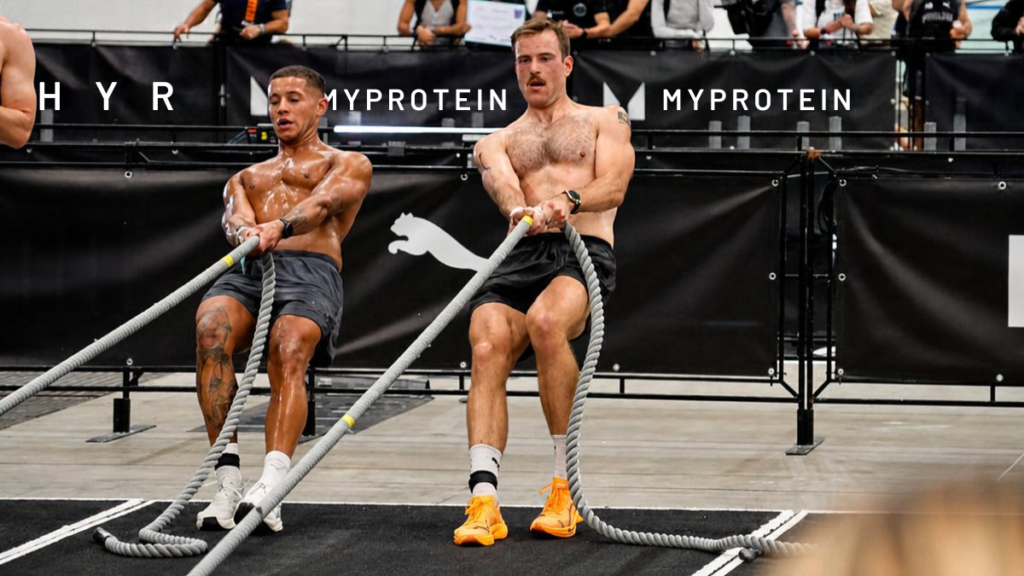
HYROX has quickly become one of the most popular competitive fitness formats in the world. It blends endurance running with functional strength movements in a standardized race that is accessible yet demanding. For beginners, stepping into a HYROX event can feel intimidating. The volume of work, the intensity of effort, and the competitive atmosphere can create a significant psychological and physical barrier.
This is where HYROX Doubles races come in. Doubles allow two athletes to share the workload, alternating movements and supporting each other throughout the race. For beginners, this format is not just a scaled down version of the event. It is a scientifically supported entry point that can improve performance, reduce injury risk, and accelerate adaptation to training stress.


What Makes HYROX Doubles Unique
Before diving into the benefits, it is important to understand how HYROX Doubles differs from the standard individual race.
In a HYROX Doubles race:
- Both athletes complete all running segments together
- Functional workout stations are shared and can be split between partners
- Athletes can alternate reps at will
- Load and intensity are reduced per individual compared to solo racing
This format creates a hybrid experience. It maintains the structure and challenge of HYROX while distributing physical and mental demands across two people.
From a scientific perspective, this changes the physiological load, pacing strategies, fatigue development, and psychological response to effort.
Benefit 1: Reduced Physiological Stress While Maintaining Training Stimulus
One of the biggest challenges for beginners is managing the physiological stress of a HYROX race. The combination of running and resistance work places a high demand on both aerobic and anaerobic systems.
Understanding Training Load and Fatigue
Training load refers to the total stress placed on the body during exercise. It includes:
- Mechanical stress from movement and load
- Metabolic stress from energy system demand
- Neuromuscular fatigue from repeated contractions
In a full HYROX race, beginners often exceed their current capacity. This can lead to excessive fatigue, poor pacing, and reduced performance. Doubles racing changes this equation by distributing workload between two athletes.
Shared Workload Improves Energy System Efficiency
When athletes alternate during functional stations, they effectively introduce intermittent recovery periods. This allows partial restoration of:
- Phosphocreatine stores
- Oxygen availability
- Neuromuscular output
Research shows that intermittent work with short rest intervals can maintain higher average power output compared to continuous effort. This is because the body can repeatedly access high intensity energy systems with partial recovery.
In practical terms, this means beginners can:
- Perform movements with better technique
- Maintain higher quality output
- Avoid early fatigue accumulation
Lower Lactate Accumulation and Improved Endurance
Lactate accumulation is a key factor in fatigue during high intensity exercise. When lactate builds faster than it can be cleared, performance declines. By sharing the workload, athletes reduce continuous effort time. This supports better lactate clearance and delays fatigue.
Studies on interval training and repeated sprint activity show that structured rest periods improve lactate buffering capacity and endurance performance over time. For beginners, this creates a more sustainable experience. Instead of hitting a wall early, they can maintain steady effort throughout the race.
Reduced Risk of Overtraining and Injury
Beginners are particularly vulnerable to overtraining because their bodies are not yet adapted to high volume and intensity. Excessive training stress can lead to:
- Muscle damage
- Joint strain
- Hormonal disruption
- Increased injury risk
Doubles racing reduces the total mechanical load per individual. This lowers the risk of acute injuries such as strains and overuse issues.
It also allows beginners to experience race intensity without exceeding safe limits. This aligns with established training principles that recommend gradual progression in load and volume.
Benefit 2: Enhanced Psychological Support and Motivation
Physical fitness is only part of the equation in HYROX. Mental resilience plays a crucial role in performance, especially for beginners who may lack confidence or experience. Doubles racing provides a powerful psychological advantage through social support and shared effort.
The Science of Social Facilitation
Social facilitation refers to the phenomenon where individuals perform better in the presence of others. This effect is well documented in sports psychology. When training or competing with a partner, athletes often:
- Increase effort levels
- Maintain focus longer
- Push beyond perceived limits
This is particularly beneficial for beginners, who may struggle with motivation during challenging moments.
Reduced Perceived Effort
Perceived exertion is a key factor in endurance performance. It reflects how hard an activity feels, not just how hard the body is working. Research shows that exercising with others can reduce perceived exertion. This means the same workload feels easier when shared with a partner.
In HYROX Doubles, athletes can:
- Take short breaks during partner work
- Mentally reset while their partner is working
- Receive encouragement during difficult moments
This reduces the psychological burden of the race.
Accountability and Commitment
Training for a race requires consistency. Beginners often struggle with adherence due to lack of structure or motivation. Having a partner increases accountability. Athletes are more likely to:
- Show up for training sessions
- Stick to a plan
- Push through discomfort
This is supported by research showing that social support improves exercise adherence and long term behavior change.
Emotional Regulation Under Stress
HYROX races are intense. Beginners may experience anxiety, self doubt, or panic during the event. A partner can help regulate these emotions by:
- Providing reassurance
- Setting pacing cues
- Offering strategic guidance
This aligns with findings in sports psychology that highlight the role of social support in managing competitive stress.
Benefit 3: Faster Skill Acquisition and Movement Efficiency
HYROX is not just about fitness. It requires specific skills and movement efficiency across a range of functional exercises. For beginners, learning these skills quickly is essential for performance and injury prevention. Doubles racing accelerates this learning process.

Observational Learning in Real Time
One of the most effective ways to learn movement is through observation. Watching a partner perform a task provides immediate feedback and modeling.
In HYROX Doubles, athletes can:
- Observe technique during partner sets
- Identify efficient movement patterns
- Apply corrections in real time
This type of learning is supported by motor learning research, which shows that observation enhances skill acquisition.
Improved Movement Quality Through Reduced Fatigue
Fatigue negatively affects movement quality. When athletes are exhausted, technique breaks down.
This can lead to:
- Inefficient movement
- Increased energy expenditure
- Higher injury risk
Because Doubles racing reduces continuous workload, beginners can maintain better form throughout the race. This reinforces proper movement patterns and builds a stronger technical foundation.
Increased Practice Volume Without Excessive Fatigue
Skill development requires repetition. However, too much repetition under fatigue can be counterproductive. Doubles racing allows beginners to accumulate volume while maintaining quality.
For example:
- Alternating sled pushes allows multiple high quality efforts
- Shared wall balls reduce fatigue per set
- Partner pacing prevents burnout
This aligns with principles of deliberate practice, where quality of repetition is more important than quantity.
Better Pacing Strategy Development
Pacing is one of the most important skills in HYROX. Beginners often start too fast and fade later in the race. Doubles racing provides an opportunity to:
- Experiment with pacing strategies
- Learn how effort levels feel over time
- Adjust based on partner feedback
Research in endurance sports shows that pacing is a learned skill that improves with experience and feedback. Having a partner accelerates this learning process.
How Beginners Should Approach HYROX Doubles
To maximize the benefits of Doubles racing, beginners should approach it strategically.
Choose the Right Partner
An ideal partner should:
- Have similar fitness levels
- Communicate well
- Share goals and expectations
Large differences in ability can create imbalance and reduce the effectiveness of the experience.
Plan Work Distribution
Before the race, decide how to split each station. Consider:
- Strengths and weaknesses
- Movement efficiency
- Fatigue management
A simple strategy is to alternate short sets to maintain consistent output.
Focus on Communication
Clear communication is essential during the race.
This includes:
- Calling transitions
- Adjusting pacing
- Providing encouragement
Effective communication improves coordination and reduces wasted time.
Prioritize Technique Over Speed
For beginners, the goal should not be maximum speed. Instead, focus on:
- Maintaining good form
- Managing effort levels
- Learning the race flow
This creates a strong foundation for future individual races.
Common Mistakes Beginners Should Avoid
Even with the advantages of Doubles racing, beginners can make mistakes that limit their progress.
Going Too Hard Early
Shared workload can create a false sense of ease at the start. Avoid sprinting early. Maintain a steady pace and build gradually.
Poor Communication
Lack of communication leads to confusion and inefficiency. Agree on signals and strategies before the race.
Uneven Work Distribution
One partner doing most of the work defeats the purpose of Doubles. Aim for balanced contribution to maximize benefits.
Ignoring Recovery Between Efforts
Use partner work periods to actively recover. Focus on breathing and preparing for the next effort.

Why HYROX Doubles Is the Ideal Entry Point
For beginners, the goal is not just to complete a race. It is to build confidence, develop fitness, and create a positive experience.
HYROX Doubles achieves this by:
- Reducing physical stress
- Enhancing psychological support
- Accelerating skill development
This combination makes it an ideal entry point into the sport. It allows beginners to experience the full structure of HYROX without being overwhelmed. Over time, this builds the capacity needed for individual racing.
Final Thoughts
HYROX Doubles is more than a scaled version of the race. It is a scientifically supported pathway for beginners to enter the sport safely and effectively.
By reducing physiological stress, enhancing psychological support, and improving skill acquisition, Doubles racing creates an optimal learning environment. For anyone new to HYROX, starting with Doubles is not a compromise. It is a smart strategy.
It sets the foundation for long term progress, better performance, and a more enjoyable experience in one of the fastest growing fitness competitions in the world.
Key Takeaways
| Benefit | What It Means | Why It Matters for Beginners |
|---|---|---|
| Reduced Physiological Stress | Shared workload lowers fatigue and improves energy efficiency | Safer entry point with lower injury risk |
| Psychological Support | Partner increases motivation and reduces perceived effort | Helps maintain consistency and confidence |
| Faster Skill Development | More practice with better technique under less fatigue | Builds strong movement foundation for future races |
References
- Borg, G. (1998). Borg’s Perceived Exertion and Pain Scales. Human Kinetics.
- Deci, E.L. and Ryan, R.M. (2000). The what and why of goal pursuits: Human needs and the self determination of behavior. Psychological Inquiry, 11(4), pp.227 to 268.
- Enoka, R.M. and Duchateau, J. (2016). Translating fatigue to human performance. Medicine and Science in Sports and Exercise, 48(11), pp.2228 to 2238.
- Gabbett, T.J. (2016). The training injury prevention paradox. Should athletes be training smarter and harder. British Journal of Sports Medicine, 50(5), pp.273 to 280.
- Hampson, D.B., St Clair Gibson, A. and Lambert, M.I. (2001). The influence of sensory cues on the perception of exertion during exercise and central regulation of exercise performance. Sports Medicine, 31(13), pp.935 to 952.
- Knicker, A.J., Renshaw, I., Oldham, A.R.H. and Cairns, S.P. (2011). Interactive processes link the multiple symptoms of fatigue in sport competition. Sports Medicine, 41(4), pp.307 to 328.