

The bicep curl is one of the first exercises many people learn when they start strength training. It is simple to perform, requires minimal equipment, and helps develop stronger and more muscular arms. Despite its simplicity, one question comes up again and again among beginners. How heavy should you actually lift?
Many new gym goers assume that heavier is always better. Others stay with extremely light weights because they worry about injury or poor technique. The truth lies somewhere in between. The best weight for beginner bicep curls is one that allows good technique while creating enough challenge to stimulate muscle growth and strength gains.



Scientific research consistently shows that beginners do not need extremely heavy weights to build muscle effectively. Learning proper movement patterns, gradually increasing resistance, and training close enough to muscular fatigue are far more important than chasing the biggest dumbbells in the gym.
This guide explains exactly how beginners should choose the right weight for bicep curls, what science says about muscle growth, how to progress safely, and which mistakes to avoid.
Why Weight Matters Less Than Most Beginners Think
Many people believe muscles only grow when lifting very heavy loads. Modern research paints a much more complete picture.
Studies comparing different training loads have found that muscles can grow effectively across a wide range of weights, provided the sets are performed close to muscular failure. Heavy weights remain superior for maximizing strength, but moderate and even relatively light loads can produce similar increases in muscle size when enough effort is applied. For beginners, this is excellent news.
Someone who has never lifted weights does not need to curl the heaviest dumbbells available. Their muscles are highly responsive to resistance training because almost any new training stimulus represents a significant challenge.
The nervous system also adapts rapidly during the first months of training. Early strength improvements often come from better coordination, improved motor unit recruitment, and learning the movement rather than large increases in muscle mass.
This makes technique the highest priority during the beginner stage.
What Is the Best Weight for Beginner Bicep Curls?
Rather than focusing on a specific dumbbell weight, beginners should choose a load based on performance. A good beginner weight allows you to perform approximately 8 to 15 repetitions with proper technique while finishing the set feeling like you could complete only one or two more repetitions. Sports scientists often describe this as leaving one or two repetitions in reserve.
If you can easily perform more than 20 repetitions without noticeable fatigue, the weight is probably too light. If you cannot complete at least six good repetitions without swinging your body or using momentum, the weight is too heavy. The ideal weight creates significant muscular effort while allowing every repetition to look almost identical.
For many healthy beginners this may mean curling anywhere from 5 to 20 pound dumbbells, depending on age, sex, previous physical activity, body size, and natural strength. The actual number matters far less than whether the weight matches your current abilities.
Why Technique Should Always Come Before Weight
One of the biggest mistakes beginners make is using their entire body to move the dumbbell.
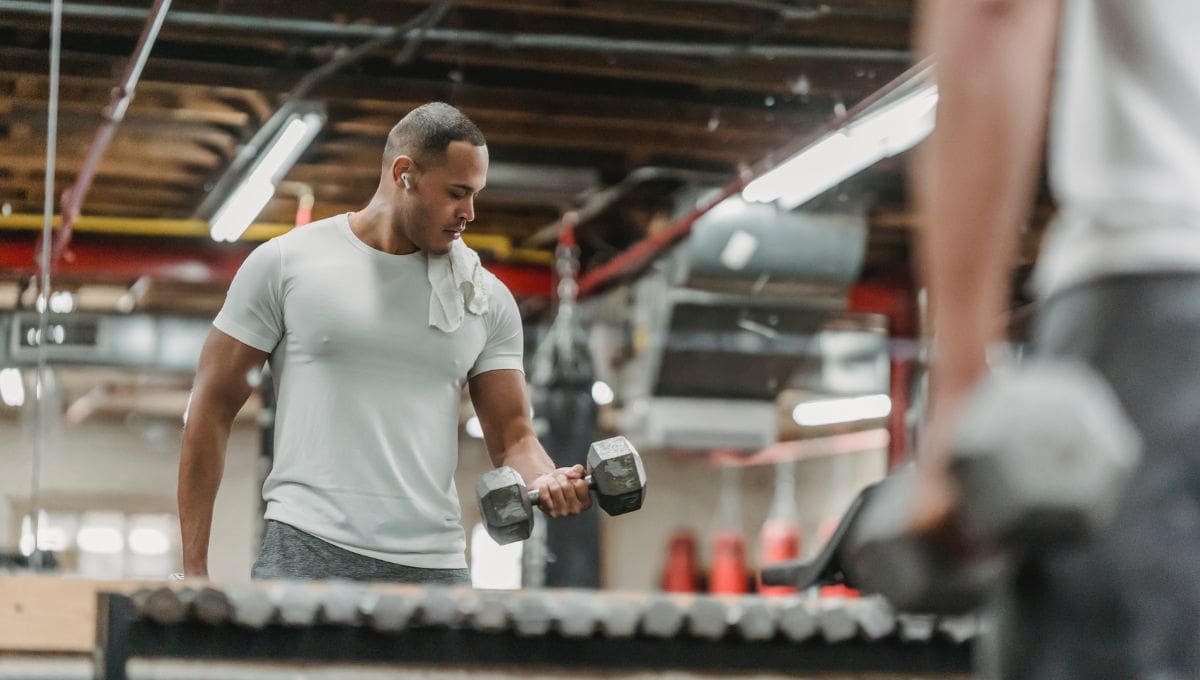
Instead of isolating the elbow flexors, they lean backward, swing the hips, shrug the shoulders, or rapidly accelerate the weight upward using momentum. This reduces tension on the biceps and increases unnecessary stress on other joints. Proper technique includes standing tall, keeping the elbows close to the torso, moving only at the elbow joint, and lowering the weight under control rather than letting gravity do the work.
Research on resistance training technique consistently shows that controlled movement improves muscle activation while reducing injury risk. Beginners benefit especially because proper movement patterns established early often remain throughout future training. Learning excellent technique with a moderate load produces far better long term results than lifting heavier weights with poor form.
How Hard Should Each Set Feel?
The sensation of effort is one of the best guides for beginners. Exercise scientists frequently use the Rating of Perceived Exertion, or RPE, to estimate training intensity. For beginner bicep curls, most sets should finish around an RPE of 8 or 9. This means the final repetitions feel difficult, but you could still complete one or two more with good form if absolutely necessary.
Stopping too early leaves valuable muscle building stimulus on the table. Going all the way to complete muscular failure on every set is also unnecessary for most beginners and may increase fatigue without producing superior long term results.
Several reviews have concluded that training close to failure provides nearly all the muscle building benefits while allowing better recovery and higher overall training quality.
How Many Sets and Repetitions Should Beginners Do?
Choosing the right weight is only one part of the equation. Research consistently supports performing multiple sets for greater muscle growth compared with only one set. For beginners, two to three working sets of bicep curls performed two or three times each week provide an effective starting point.
A repetition range between 8 and 15 works especially well because it combines moderate resistance with enough practice to reinforce proper movement. This approach allows beginners to accumulate sufficient training volume without excessive soreness or fatigue. Over time, additional sets can be introduced as recovery and work capacity improve.
Should Beginners Lift Heavy for Strength?
Heavy weights certainly improve strength. Loads above approximately 80 percent of one repetition maximum produce excellent strength adaptations because they challenge the nervous system to recruit large numbers of muscle fibers. However, beginners rarely need to train this heavily during isolation exercises like bicep curls.
Large compound lifts such as rows, pull ups, and deadlifts already expose the biceps to relatively high forces while developing whole body strength. Using moderate loads during curls allows beginners to improve muscle control while minimizing unnecessary stress on the elbows and wrists. After several months of consistent training, slightly heavier curls can become part of a well rounded program.
The Importance of Progressive Overload
The body adapts surprisingly quickly. A weight that feels challenging during your first week may become relatively easy after a month of consistent training. Progressive overload simply means gradually increasing the demands placed on the muscles over time. This does not always require adding more weight.
You can also perform additional repetitions, improve technique, increase the number of sets, or slow the lowering phase to increase muscular tension. Eventually, however, adding weight becomes necessary for continued progress. A practical strategy is simple. When you can complete all planned repetitions with excellent technique while still feeling capable of several more repetitions, increase the dumbbell by the next available increment.
Small increases performed consistently over months produce substantial improvements in strength and muscle size.
How Fast Should Beginners Increase Weight?
There is no universal schedule. Some beginners can increase dumbbell weight every one or two weeks during the first months because neurological adaptations occur rapidly. Others progress more gradually.
Trying to increase weight before mastering technique usually slows long term progress. Instead, focus on consistent improvement. If you perform all planned sets with clean form for two consecutive workouts and still finish with energy left in reserve, it is probably time to move to the next heavier dumbbell. Small, regular improvements are far more sustainable than making large jumps.
Pull Up vs Cable Row – Which is the Best Exercise for Beginners to Build a Wider Back?
What If the Weight Feels Different Every Workout?
This is completely normal. Sleep quality, nutrition, hydration, stress, and previous training sessions all influence performance.
One day an 18 pound dumbbell may feel easy. The next day the same weight may feel unexpectedly heavy. Rather than forcing progression every workout, adjust based on how you perform that day. This flexible approach aligns with autoregulation, which has gained considerable support in sports science because it helps athletes match training intensity to daily readiness.
Listening to performance rather than ego often produces better long term consistency.
Can Beginners Build Bigger Arms Without Heavy Curls?
Absolutely. Muscle growth depends primarily on sufficient training volume, progressive overload, proper nutrition, and adequate recovery. Research comparing different loading schemes repeatedly demonstrates that lighter and moderate weights can produce muscle hypertrophy comparable to heavier loads when sets are performed with sufficient effort.
Beginners often experience particularly rapid improvements because their muscles respond strongly to nearly any structured resistance program. Combined with adequate daily protein intake and sufficient calories, moderate weight curls performed consistently can produce impressive arm development over the first year of training.
Supporting Nutrition for Better Results
Even the perfect training program cannot compensate for poor nutrition. Muscle protein synthesis increases after resistance exercise, especially when sufficient dietary protein is consumed.
Current evidence suggests that most active individuals seeking muscle growth benefit from consuming approximately 1.4 to 2.2 grams of protein per kilogram of body weight each day. Spreading protein intake across several meals appears to maximize muscle protein synthesis throughout the day.
Carbohydrates also support performance by replenishing muscle glycogen, while adequate sleep allows recovery and adaptation to occur. Strength training, nutrition, and recovery work together as one complete system.
The Bottom Line
Beginners do not need to curl the heaviest dumbbells in the gym to build stronger and bigger arms. The ideal weight is one that allows roughly 8 to 15 controlled repetitions while finishing each set with only one or two good repetitions left in reserve. Proper technique should always take priority over heavier loads because learning efficient movement patterns creates the foundation for future progress.
As strength improves, gradually increasing resistance through progressive overload ensures continued adaptation. Combined with sufficient protein intake, regular training, and adequate recovery, moderate weight bicep curls provide everything most beginners need to develop stronger, healthier, and more muscular arms.
Key Takeaways
| Recommendation | Why It Matters |
|---|---|
| Choose a weight that allows 8 to 15 controlled repetitions | This provides an effective balance between technique, muscle growth, and strength development |
| Finish each set with one or two repetitions left in reserve | Training close to failure stimulates muscle growth while limiting unnecessary fatigue |
| Prioritize perfect technique before increasing weight | Good movement patterns improve muscle activation and reduce injury risk |
| Perform two to three sets, two or three times each week | This provides sufficient training volume for most beginners |
| Increase weight gradually | Progressive overload supports continuous improvements in strength and muscle size |
| Support training with adequate protein and recovery | Nutrition and sleep maximize muscle repair and adaptation |
References
- American College of Sports Medicine. (2009) ‘Progression models in resistance training for healthy adults’, Medicine & Science in Sports & Exercise, 41(3), pp. 687 to 708.
- Grgic, J., Schoenfeld, B.J., Orazem, J. and Sabol, F. (2022) ‘Effects of resistance training performed to repetition failure or non failure on muscular strength and hypertrophy’, Journal of Sport and Health Science, 11(2), pp. 202 to 211.
- Morton, R.W., Murphy, K.T., McKellar, S.R., Schoenfeld, B.J., Henselmans, M., Helms, E., Aragon, A.A., Devries, M.C., Banfield, L., Krieger, J.W. and Phillips, S.M. (2018) ‘A systematic review, meta analysis and meta regression of the effect of protein supplementation on resistance training induced gains in muscle mass and strength in healthy adults’, British Journal of Sports Medicine, 52(6), pp. 376 to 384.
- Peterson, M.D., Rhea, M.R. and Alvar, B.A. (2004) ‘Maximizing strength development in athletes: A meta analysis to determine the dose response relationship’, Journal of Strength and Conditioning Research, 18(2), pp. 377 to 382.
- Schoenfeld, B.J. (2010) ‘The mechanisms of muscle hypertrophy and their application to resistance training’, Journal of Strength and Conditioning Research, 24(10), pp. 2857 to 2872.
- Schoenfeld, B.J., Grgic, J., Ogborn, D. and Krieger, J.W. (2017) ‘Strength and hypertrophy adaptations between low load and high load resistance training: A systematic review and meta analysis’, Journal of Strength and Conditioning Research, 31(12), pp. 3508 to 3523.
- Schoenfeld, B.J., Ogborn, D. and Krieger, J.W. (2016) ‘Dose response relationship between weekly resistance training volume and increases in muscle mass: A systematic review and meta analysis’, Journal of Sports Sciences, 35(11), pp. 1073 to 1082.