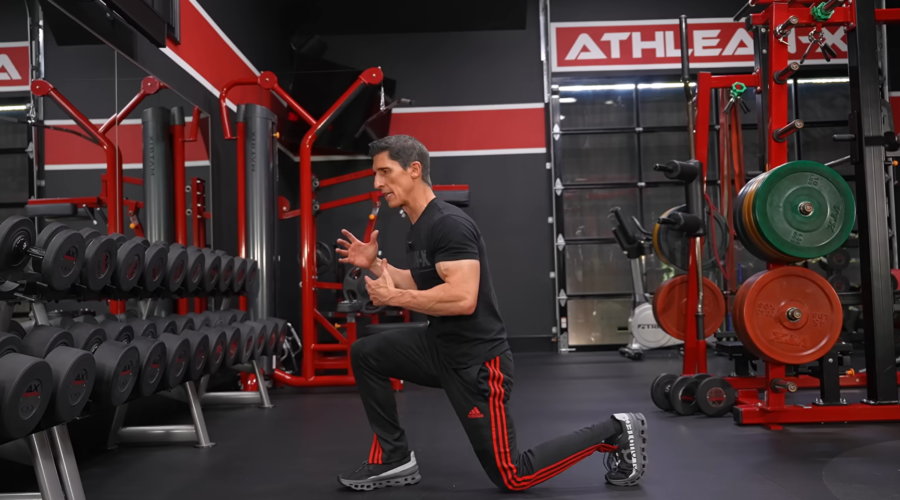


Jeff Cavaliere believes the lunge is one of the best lower-body exercises available, but also one of the most commonly performed incorrectly. According to the ATHLEAN-X founder, poor technique can place unnecessary stress on the knees while reducing the exercise’s effectiveness for building stronger quads, glutes, and hamstrings.
In a recent YouTube video, Cavaliere broke down six adjustments that can help lifters perform lunges more safely while maximizing muscle development.


Choose the Right Lunge Direction
“The most popular happens to be the most stressful to your knee joint.”
Cavaliere starts by comparing forward and reverse lunges. He explains that stepping forward forces the lead leg to absorb impact when the foot lands, increasing stress on the patellofemoral joint and patellar tendon.
By contrast, the reverse lunge keeps the front foot planted throughout the movement, allowing athletes to control both the descent and ascent while reducing unnecessary knee loading. Those who prefer forward lunges should consider walking lunges, which improve movement mechanics, although they do not eliminate the additional landing forces.
Improve Stability With Better Foot Placement
“Step back and out.”
Another common mistake is placing both feet directly in line, turning the exercise into a balance challenge instead of an effective strength movement.
Cavaliere recommends stepping backward and slightly outward to create at least a shoulder-width base. To determine the correct stride length, simply reach back until the toes touch the floor, then lower straight down. He says this creates a repeatable setup that matches each person’s leg length.
Use Your Upper Body to Create Stability
“Rotate your shoulders towards the lunging leg.”
Although lunges primarily train the lower body, Cavaliere says upper-body positioning plays a major role in stability.
A slight shoulder rotation toward the front working leg helps stabilize the pelvis, reducing unwanted hip movement and allowing athletes to focus on producing force rather than fighting to maintain balance.
Match Your Torso Position and Load to Your Goal
“Changing your position… is going to dramatically change the focus of the muscles you’re trying to target.”
Keeping the torso upright emphasizes the quadriceps, similar to a front squat. Leaning slightly forward from the hips shifts more of the workload toward the glutes and hamstrings in what Cavaliere calls a sprinter lunge.
He also recommends matching the loading method to the variation. Dumbbells work best for posterior chain-focused lunges because they allow a natural forward lean, while barbells or goblet holds better suit upright, quad-focused lunges.
Control Your Depth Instead of Forcing It
“The knee can actually make contact with the ground… it can kiss the ground.”
Cavaliere explains that full-depth lunges are ideal, but depth should always match an individual’s mobility.
The back knee can lightly touch the floor as a depth marker, provided it doesn’t crash into the ground. If limited ankle mobility or other orthopedic restrictions prevent full depth, he advises stopping at the deepest controlled position rather than compensating with excessive forward lean.
Takeaway
For Cavaliere, improving the lunge isn’t about replacing the exercise but refining its execution. By choosing reverse lunges when appropriate, improving foot placement, stabilizing the torso, selecting the right loading strategy, and working within a controlled range of motion, athletes can build stronger legs while reducing unnecessary knee stress.
About the Author
Jeremiah Oliva

Jeremiah Oliva is a writer passionate about fitness, sports, and active living. He has experience in songwriting and managing content and social media for online radio and magazine platforms.
He covers HYROX, CrossFit®, and competitive fitness, with a focus on performance, mindset, and athlete development.
Outside of writing, Jeremiah trains in boxing, cycles, explores the outdoors with his kids, and plays the guitar.